Strategic Partnership Opportunity
Structural and Mechanical Safety and Resilience LLC
 We do not seek funding. We seek strategic partners for global licensing
Contact SMSR Global
For partnership inquiries, technical questions, or NDA requests, please use the form below or email us directly.
Projects
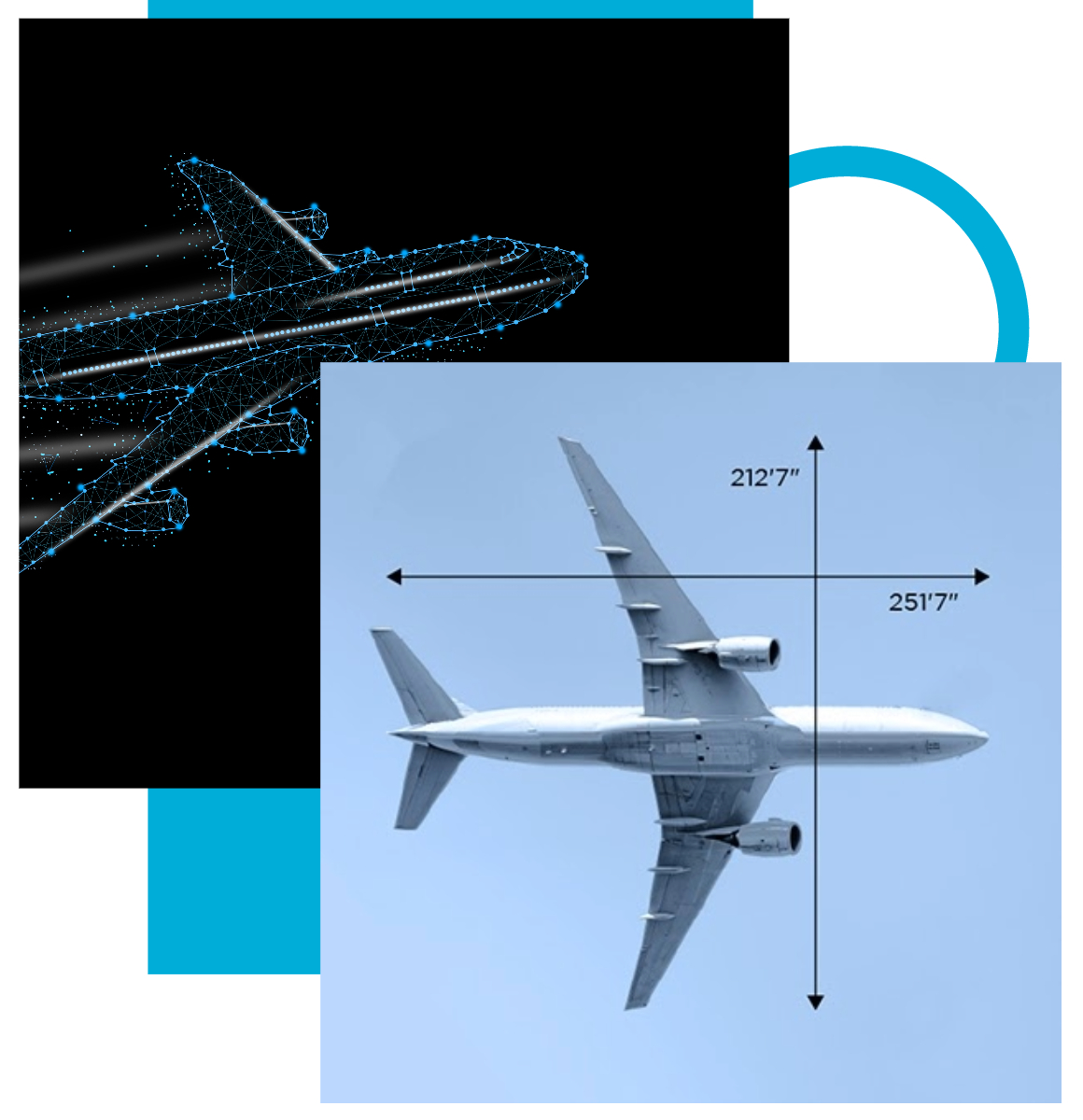
Projects ...We built a 3.25-meter UAV wing. Then we scaled it to a Boeing 777.
Same philosophy. Same hybrid materials platform. One design, applied at two completely different scales.
The results — from our analytical, computational, and physical testing — are not incremental. They are structural.
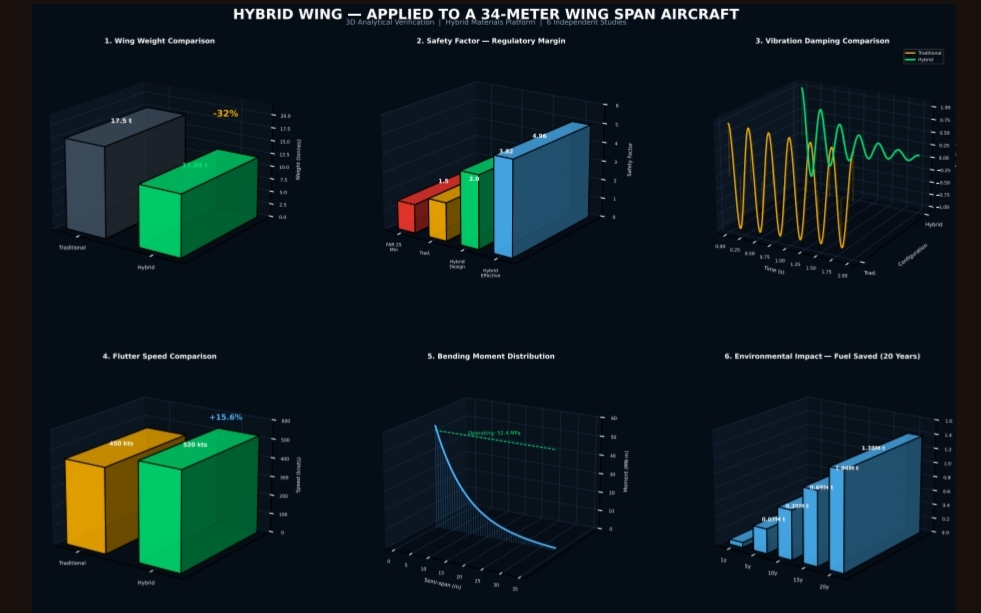
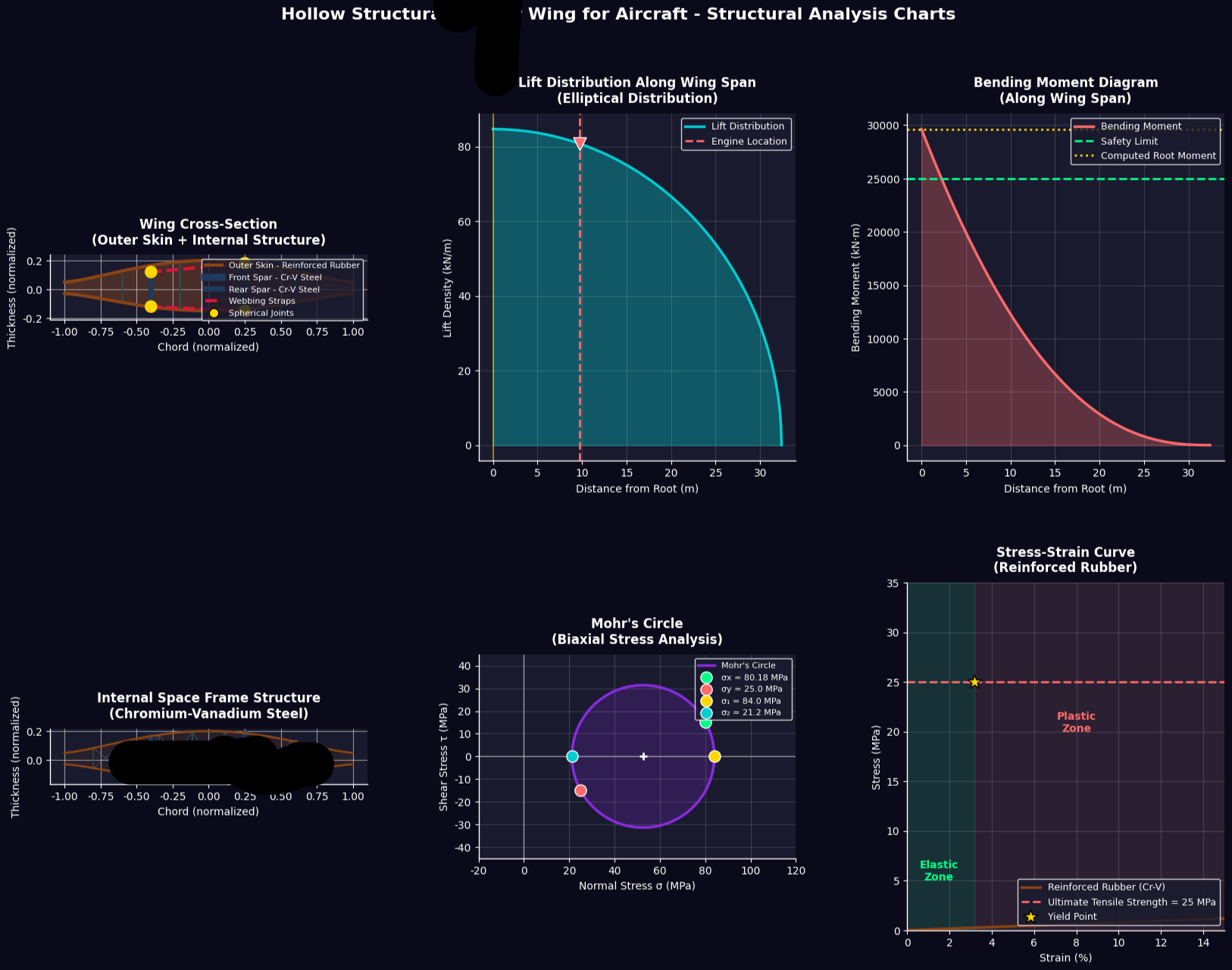
What we found when applying our hybrid wing to a 34-meter aircraft wing:
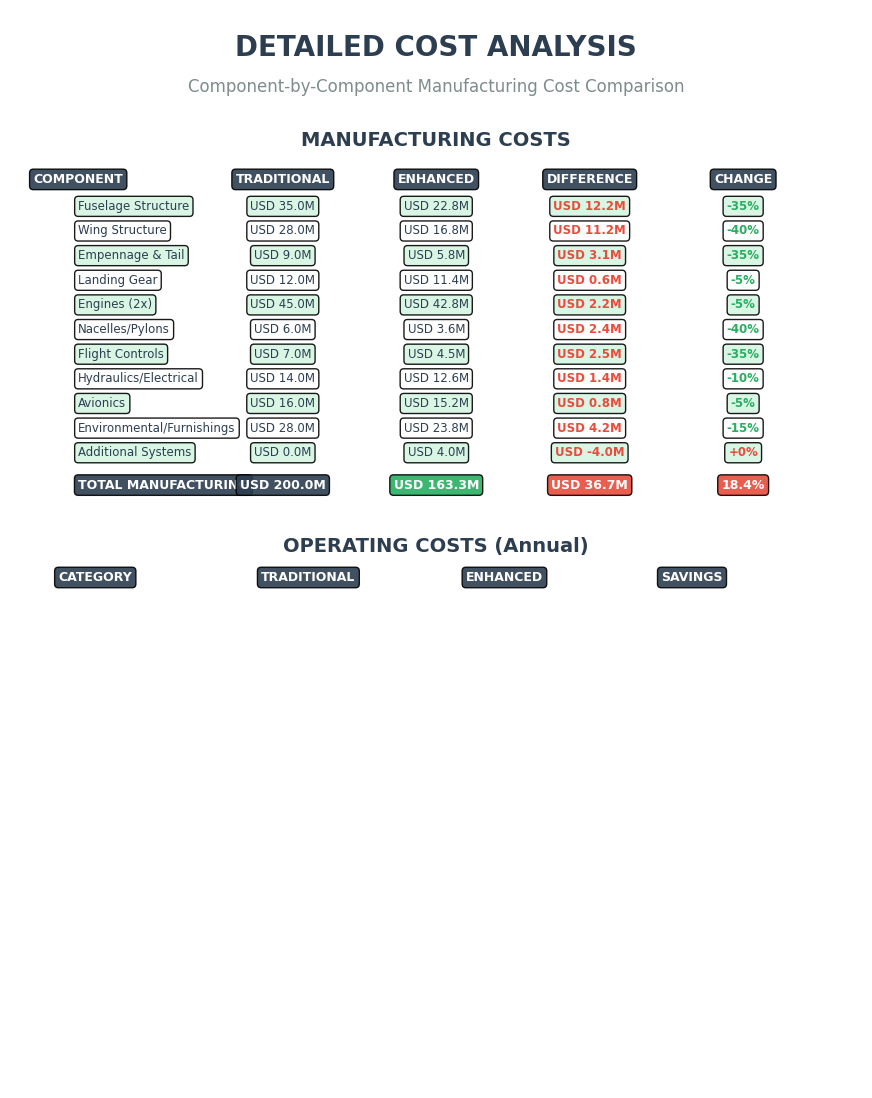
• Weight: 11.89 tonnes vs 17.5 tonnes traditional — 32% lighter
• Safety Factor: 3.82 design / 4.96 effective — 2.55× above FAR 25 minimum
• Vibration Damping: 6× better than conventional wings
• Flutter Speed: 520 knots vs 450 — 15.6% higher margin
• Fuel Saved Per Flight: 23,073 kg
• CO₂ Reduced Per Flight: 72.9 kg
• Cost: Up to 47% lower than conventional wing manufacturing
And the materials? Not aluminum. Not titanium. Not carbon fiber alone. A hybrid platform that combines stiffness with flexibility — two properties the industry has treated as mutually exclusive for a century.
Why does this matter?
Because aerospace has been optimizing the same materials for 90 years. Aluminum fatigues. Carbon fiber shatters. Titanium is expensive. Every improvement has been incremental — 3% here, 5% there.
We did not optimize. We started over.
The same platform that lifts a 500 kg payload on a UAV wing can carry the structure of a wide-body aircraft. The same material that absorbs impact can damp vibration. The same design that is 32% lighter is also 2.55× safer.
This is not a concept.
The prototype is built. The tests are done. The numbers are documented. We scaled it — on paper, in simulation, with the same physics that built the first one.
We are not asking for investment. We are not asking for belief.
We are asking one question:
If a small independent team can redesign the aircraft wing — what is the rest of the industry still doing?
-
Our successful ad campaign for a high-profile client resulted in a 15% increase in sales.
Our 112 Patents – 11 Technology Families
 A unified platform of structural and mechanical safety and resilience innovations.
-
 A specialized portfolio of core patent families focusing on advanced engineering research, structural integrity, and innovative mechanical safety systems designed to withstand extreme environments
Why do so many structures fail — despite decades of advanced research?
Because engineering has been trained to optimize for rigidity. Rigidity alone is not resilience.
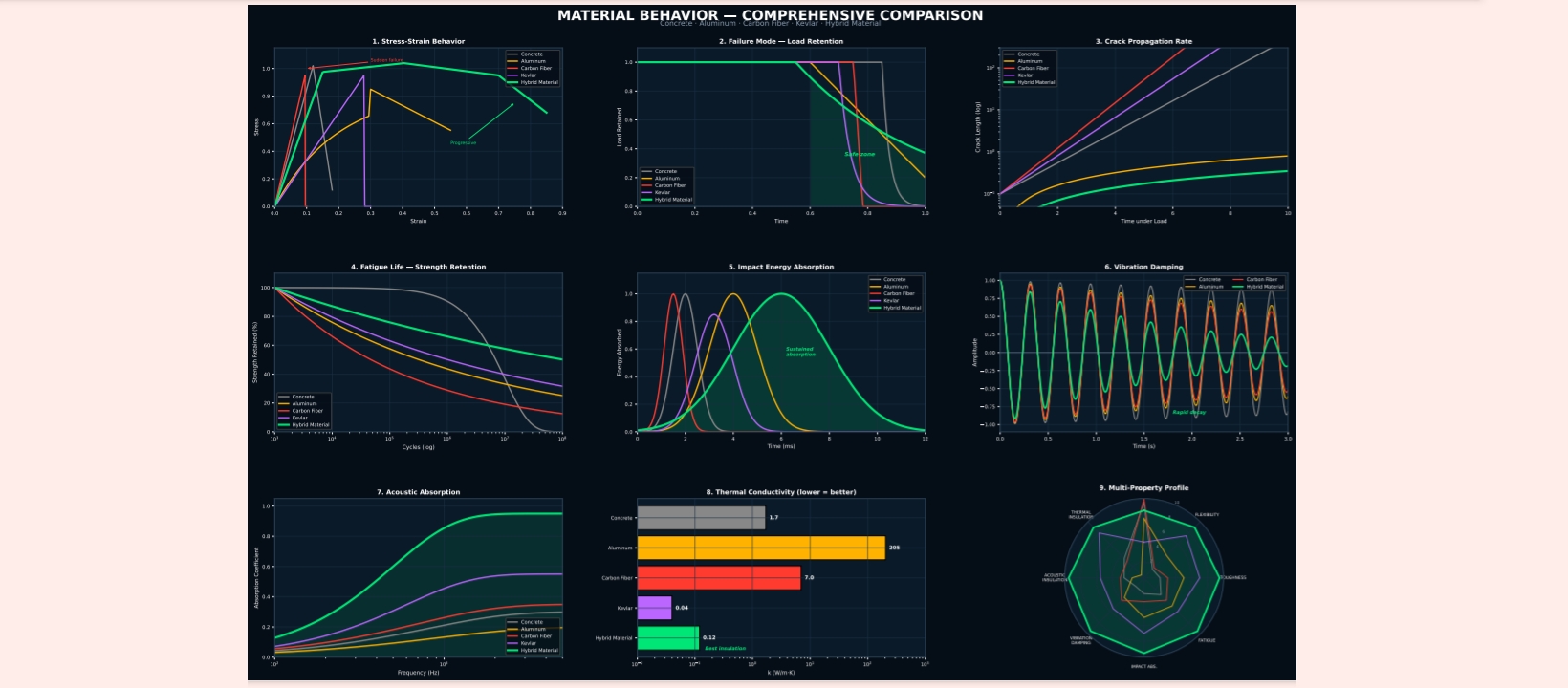
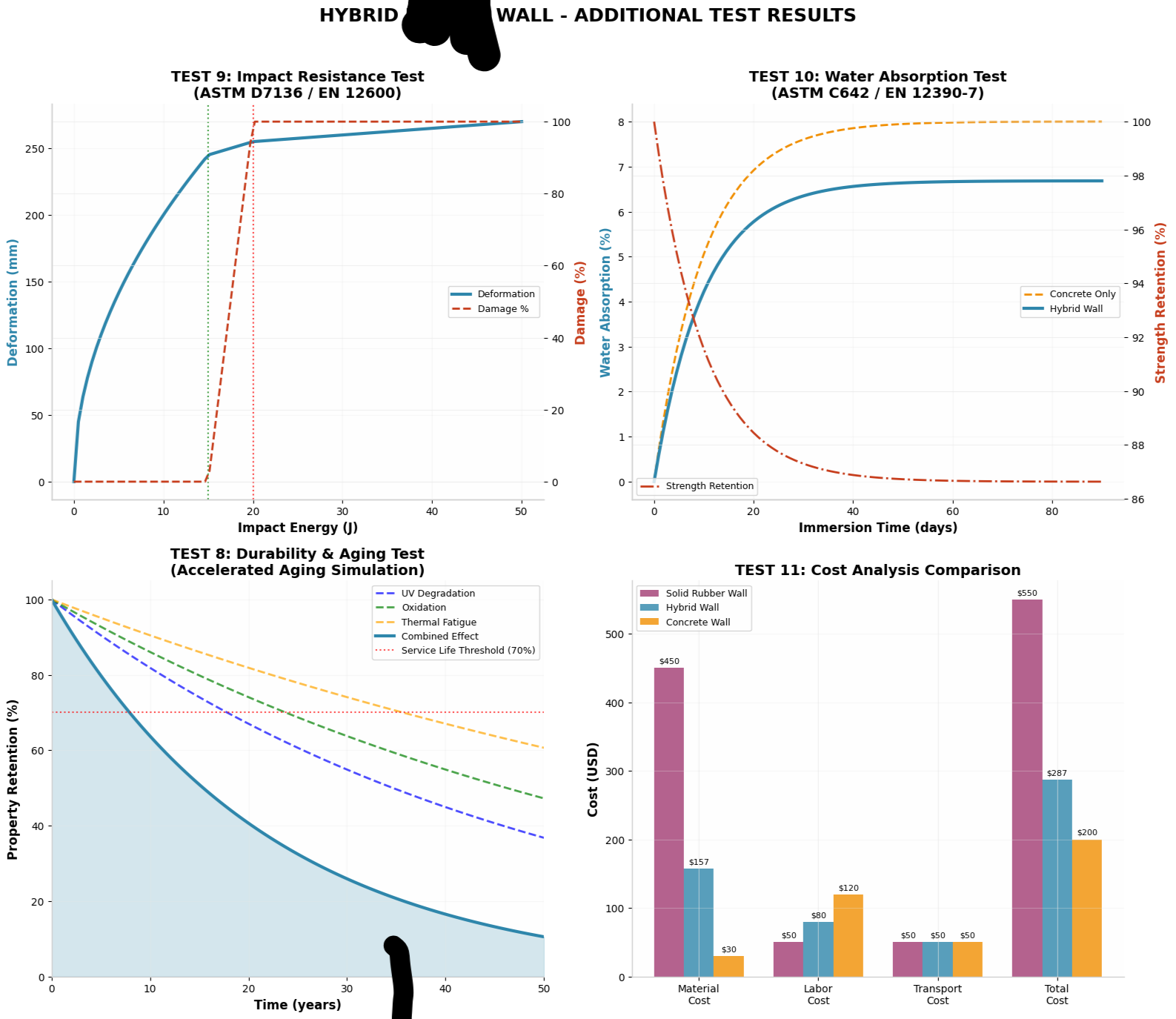
We ran a comparative analysis across eight physical properties. Five materials. Concrete. Aluminum. Carbon fiber. Kevlar. And our Hybrid Material.
The results were not what the textbooks predict.
1. Stress-Strain
Concrete reaches peak strength, then fails without warning. Carbon fiber is stiffer, but breaks abruptly. Kevlar stretches but never reaches high load. Aluminum yields gradually, then loses strength early. Only the Hybrid Material holds high stiffness while continuing to deform safely.
2. Failure Mode
After the peak, concrete collapses. Carbon fiber drops to zero in milliseconds. Aluminum retains partial load briefly. The Hybrid Material retains meaningful load far longer — a wide safe zone where integrity still holds.
3. Crack Propagation
Carbon fiber and concrete show exponential crack growth. Aluminum propagates linearly. The Hybrid Material shows the slowest growth by a wide margin.
4. Fatigue Life
At 10 million cycles, carbon fiber and aluminum retain less than half their strength. The Hybrid Material retains the highest percentage up to 100 million cycles.
5. Impact Absorption
Concrete and carbon fiber absorb energy in a short, sharp spike. The Hybrid Material absorbs over a longer duration — less force reaches the structure behind it.
6. Vibration Damping
Concrete and aluminum oscillate for seconds. Carbon fiber barely dampens. Hybrid oscillations decay within a fraction of a second.
7. Acoustic Absorption
At 5000 Hz: concrete ~0.30, aluminum ~0.15, carbon ~0.30, Kevlar ~0.50. Hybrid approaches 0.95.
8. Thermal Insulation
Aluminum: 205 W/m·K. Concrete: 1.7. Carbon: 7.0. Hybrid: 0.12 — outperforming all as a thermal barrier.
9. Multi-Property Profile
Every traditional material excels in one or two dimensions and fails in others. Concrete is rigid but brittle. Aluminum is ductile but fatigues. Carbon is strong but catastrophic. Kevlar is flexible but weak.
The Hybrid Material is the only one occupying the full profile — without compromising any single axis.
The philosophy:
Rigidity without flexibility breaks.
Flexibility without rigidity deforms.
Resilience requires both — at the same time.
This is what we mean by a unified platform.
Part of our ongoing work on hybrid materials — currently under registration.
Ahmed Elmasaad — SMSR Global
ORCID: 0009-0008-0607-7240
#Engineering #Materials #HybridMaterials #StructuralEngineering #Innovation #Research #Sustainability #DeepTech
-

-
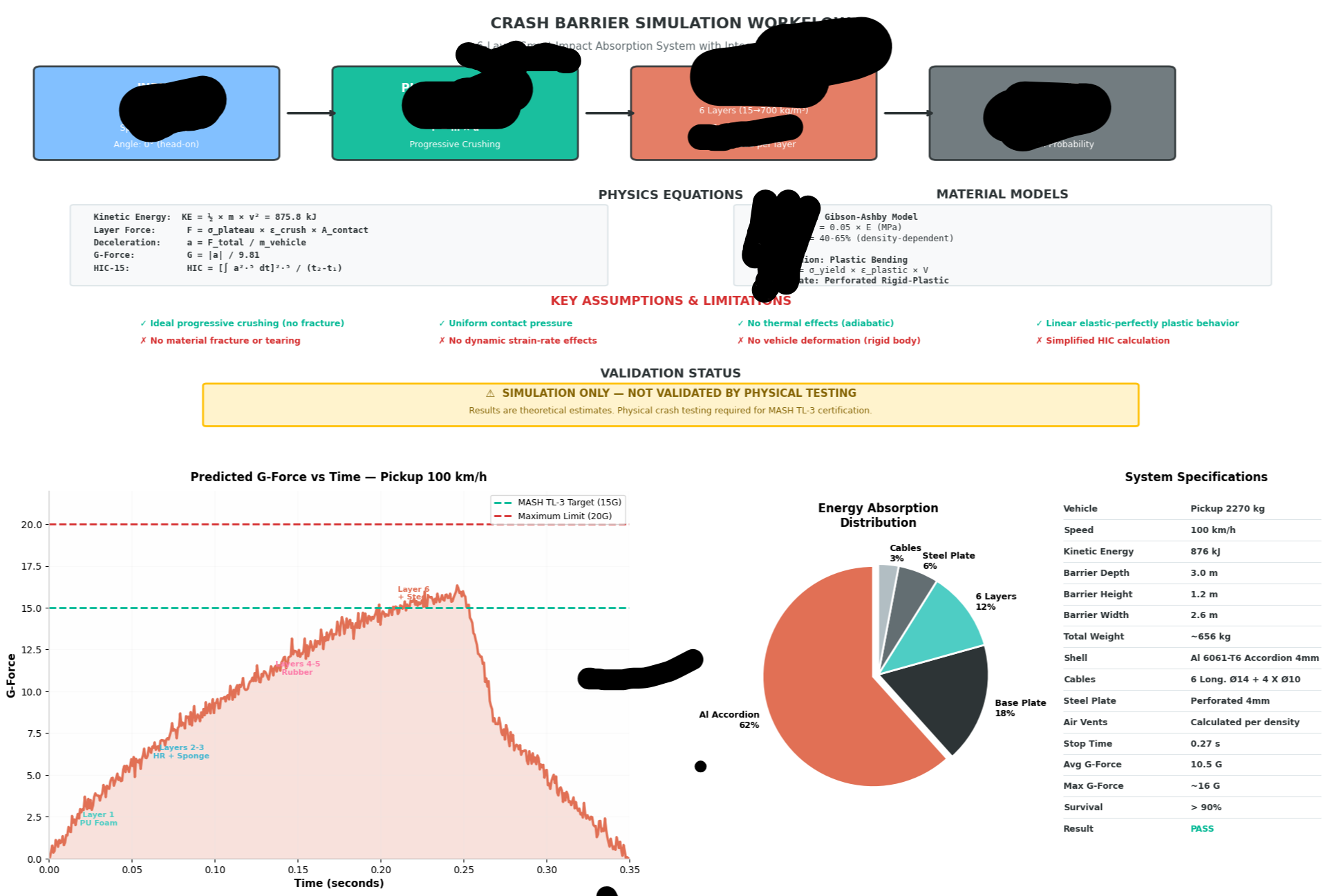
1. Smart TMA System
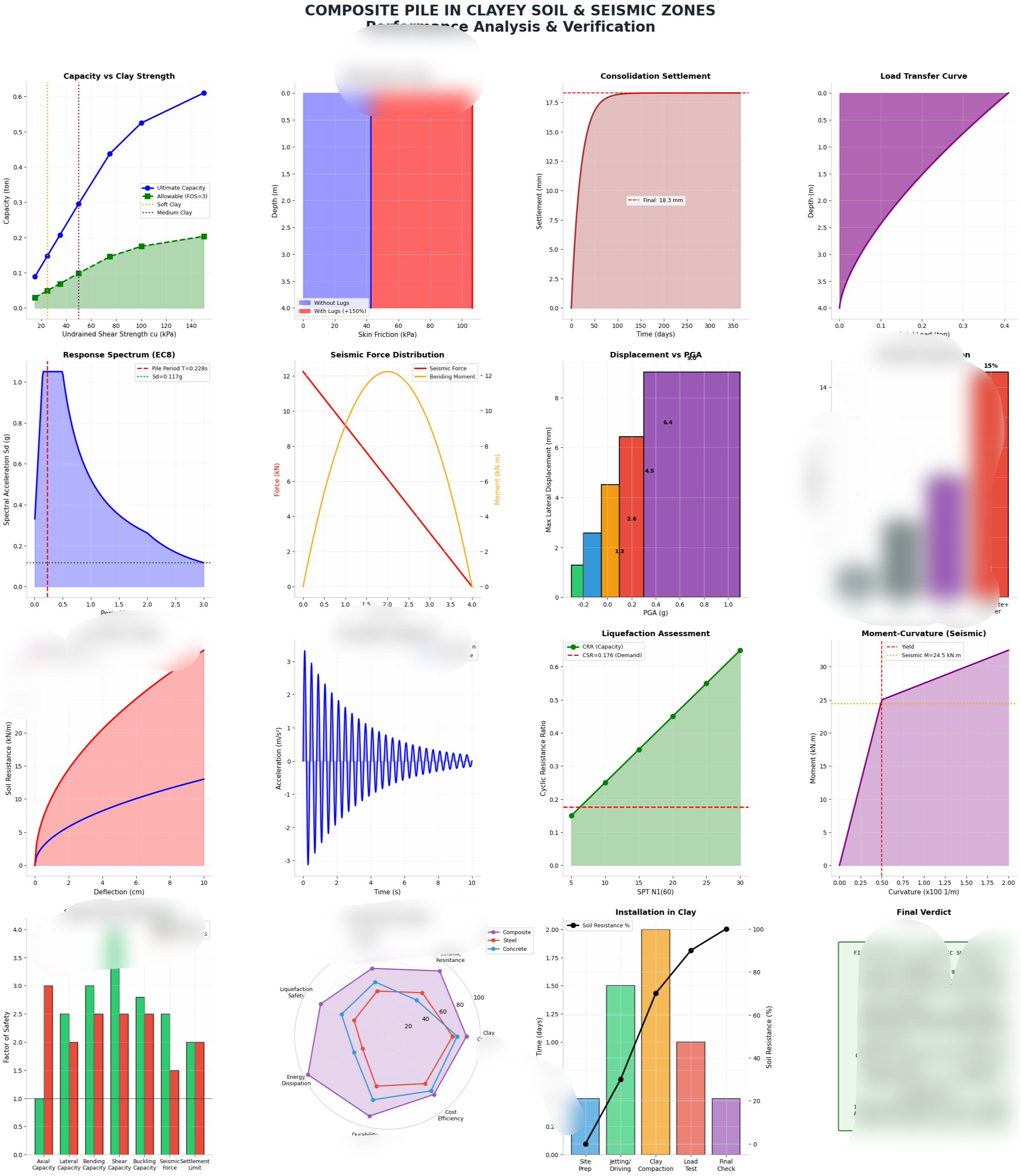
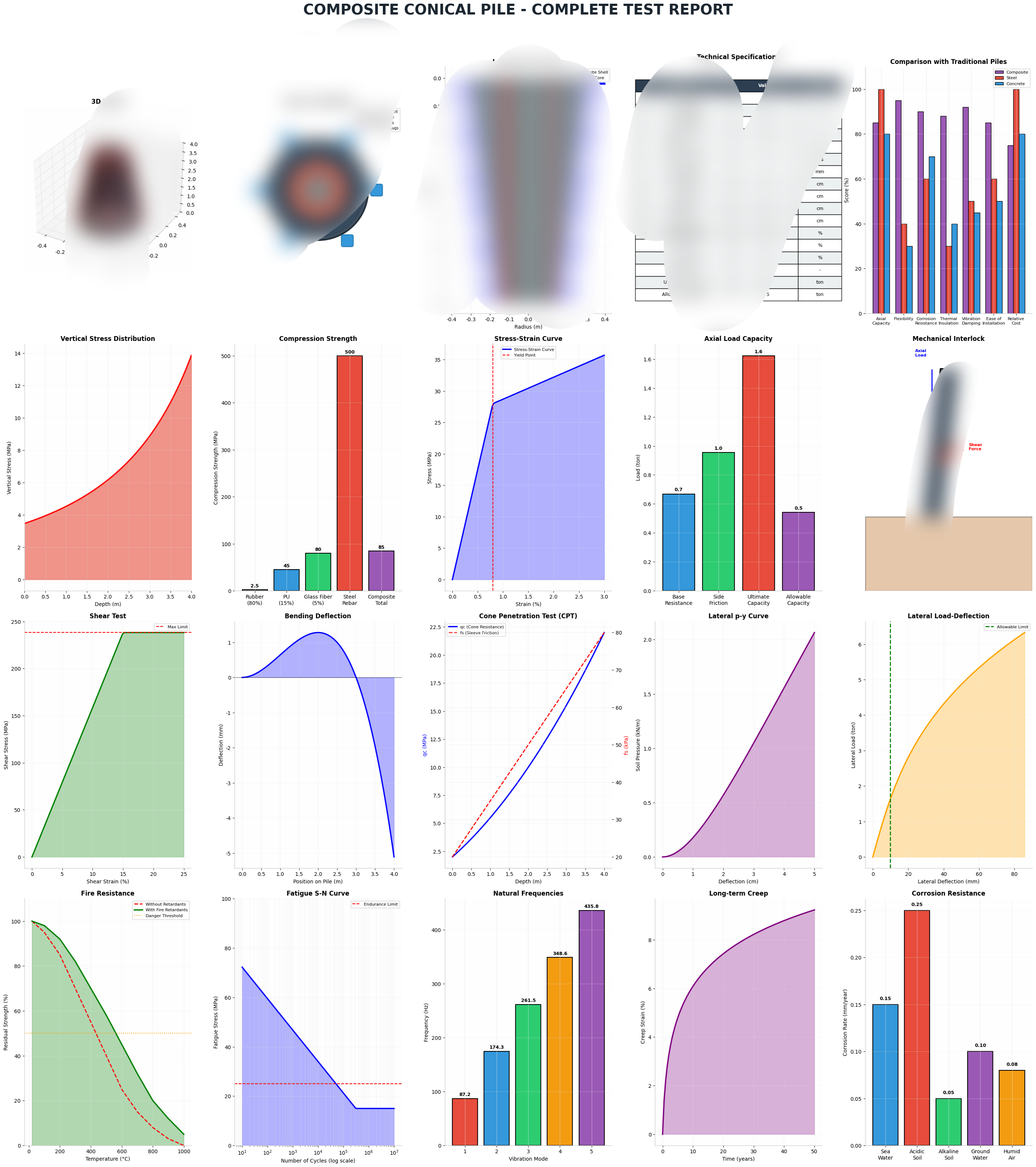
2. Composite Tapered Pile
3. Hybrid Foundation System
4. Proactive Airbag Platform for Buses
5. Composite Rescue Capsule
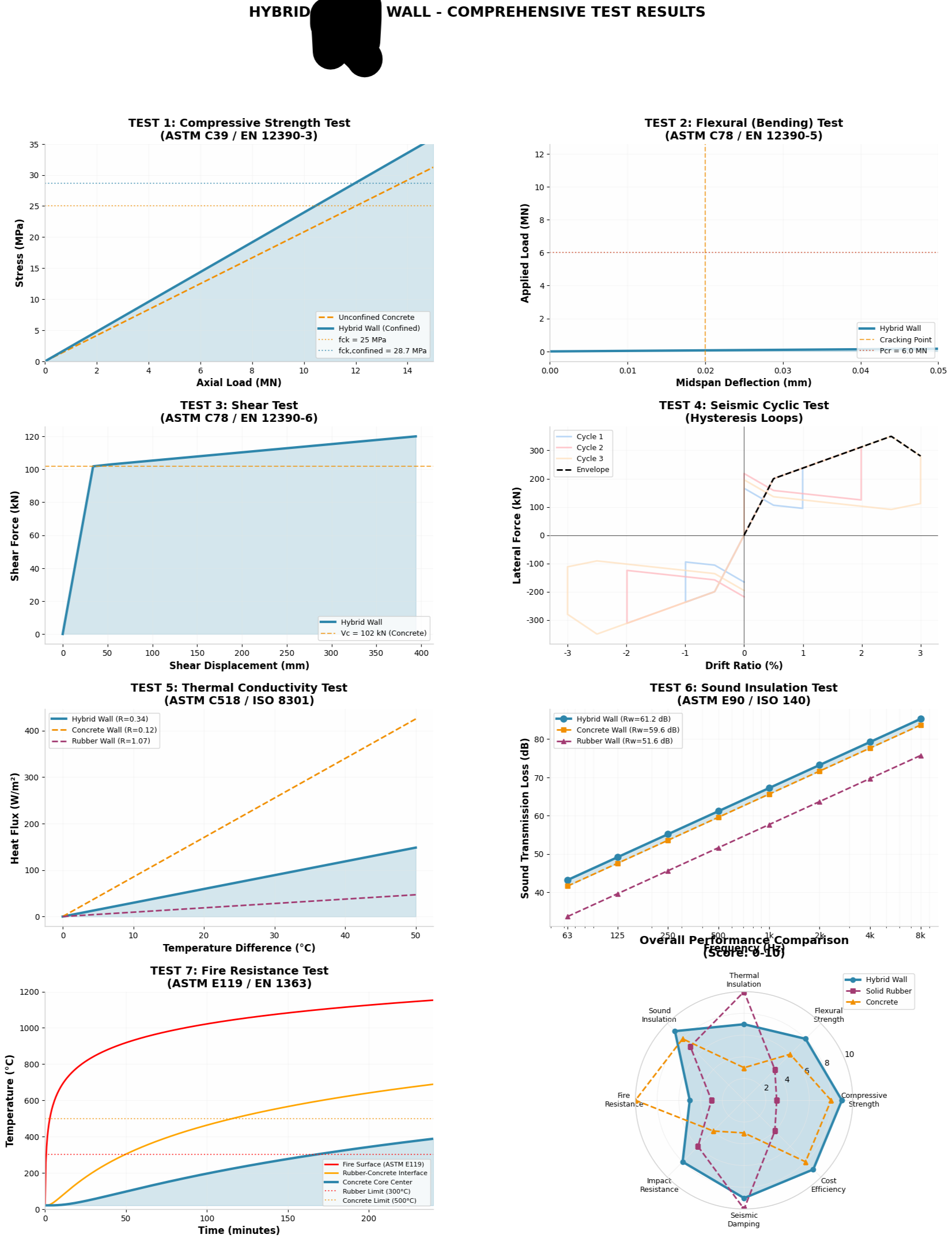
6. Reinforced Wall and Modular Construction System
7. Underwater Cities
8. Hydrostatic Balance System for Submarines
9. Collapsible Emergency Runways
10. Triangular Actuator
11. Hybrid Composite Material
12. Reinforced Electricity Poles
13. Reinforced Railway Base
14. Reinforced Manhole Cover
15. Reinforced Sewage Pipe
16. Standardized Marine Protection System for Ships
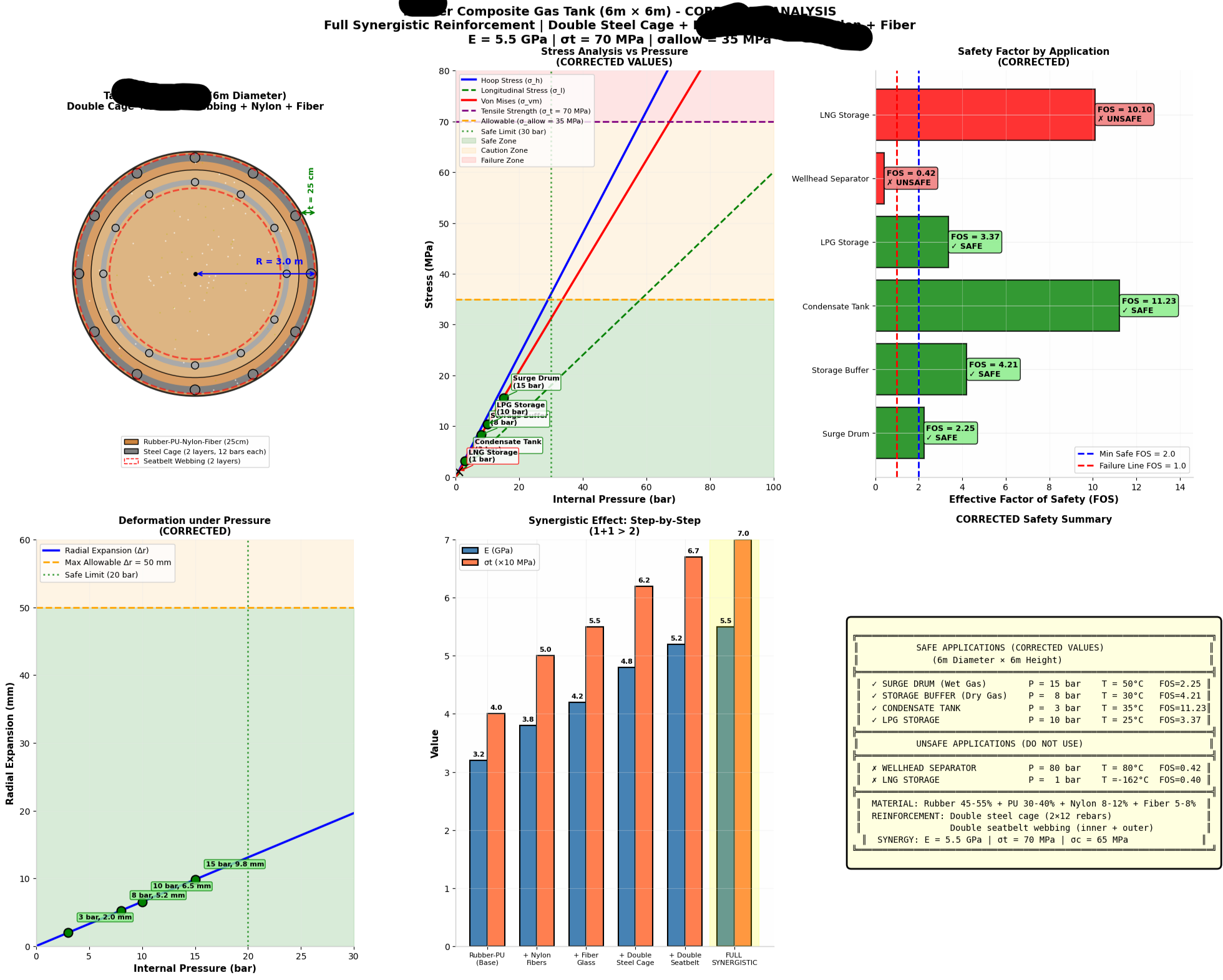
17. Composite Fuel Tanks
18. Composite Water Tanks
19. Ring Tunnel Supports
20. Inflatable Ring Well Supports
21. Standardized Reinforced Building Support System
22. Composite Reinforced Doors
23. Protective Cover for Tree Trunks
24. Circular Building Protection System Against Floods
25. Pyramid Dam System
26. Large Reinforced Gas Tanks
27. Small Portable Gas Cylinders
28. Insulated Cell System for Tank Burial
29. Standardized Self-Stressing Triangle System for Joints
31. Unsinkable Bio-Structure System for Aircraft
32. Parachute Escape Cabin System for Small Aircraft
33. Double Aircraft Fuselage
34. Standard Reinforced Furniture
35. Standard Luxury Modular Furniture
36. Sprayed Facade Coating
37. Full Vehicle (Complete Car)
38. Car Seats
39. External Wrapping System for Metal Tanks
40. Internal Triangular Reinforcement System for Tanks
42. Animal Shelters
43. Giant Children‘s Play Equipment
44. Pyramid Wave Energy Converter
45. Wave Energy Concentration Matrix
46. Pyramid-Based Marine Current Energy Generation
47. Inflatable Platform for Floating Structures
48. Seasonal Hauling and Discharging System
49. Multi-Face Pyramid Offshore Power Station
50. Integrated Offshore Energy Farms
51. Bio-Energy Converter
52. Smart Wave Breaker for Beach Nourishment
53. Self-Repairing Emergency Bridge
54. Enhanced Piezoelectric Material
55. Smart Floor for Energy Generation and Heating
56. Rescue Vest for Concrete Column Restoration
57. Structural Insulating Foundation Mat
58. Eternal Reinforced Swimming Pool
59. Mobile Floating Hotel
60. Floating Tourist Villages
61. Standardized Housing Units for the Homeless
62. Developed Animal Shelters
63. Developed Giant Children‘s Play Equipment
64. Self-Activating Building Fire Suppression System
65. Mobile Intensive Care Unit
66. Soft Robot
67. Smart Future Shelter
68. Fire Suppression Systems
69. Reinforced Limb for Prosthetics
70. Dynamic Arched Barrier Against Sand Encroachment
71. Solar Cooling Tree
72. Portable Treehouse Cabin
73. Inflatable Double-Wall Building
74. Self-Erecting Concrete Building
75. Dynamic Vehicle Rescue Net
76. Standardized Mesh for Covering Mountain Slopes
77. Reinforced Bladder for Roadway Electricity Generation
78. Desert Air Cooler
79. Integrated Anti-Slip Bathroom
80. Ultra Sound Absorber
81. Reinforced Ship
82. Standardized Multi-Tank Flotation System
83. Variable Contact Tire
85. Flexible Mortar
86. Smart Dome with Telescopic Plug
87. Emergency Shut-Off Pipe
88. Reinforced Staircase
90. Smart Soil Granules
91. Giant Solar Bladder for Water Desalination
92. Non-Explodable Airship
94. Manual Insulation Machine for Aerial Wires
96. Sacrificial Heat Shield for Spacecraft
97. Armored High-Output Membrane Oxygen Separation Device
98. Graphene Magnetic Bio-Heart
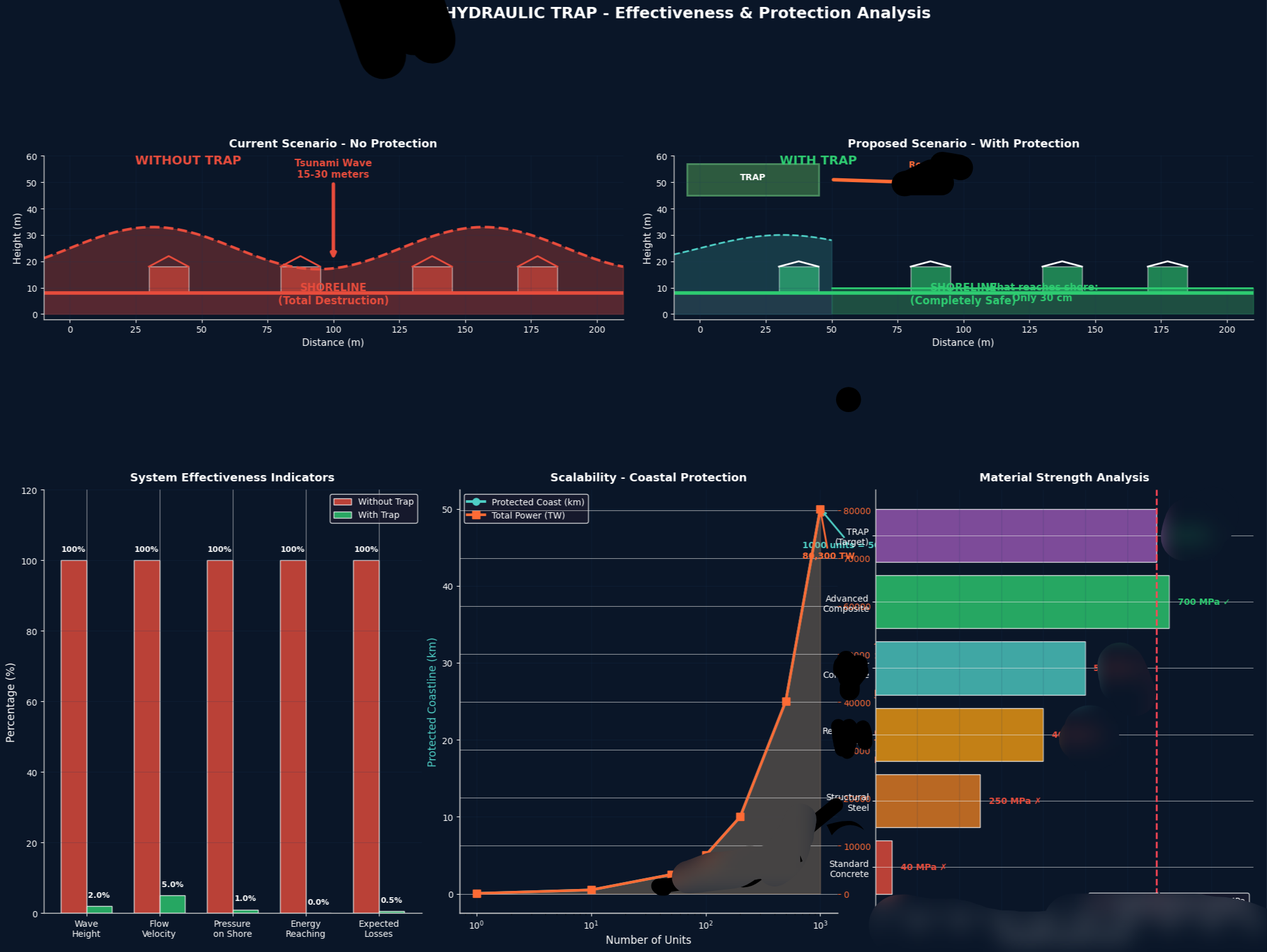
99. Smart Dynamic Self-Balancing Coastal Defense System Against Tsunamis
100. Modular Food Drawers
101. Multi-Piston Reinforced Hydraulic Pump
102. Ultra-Quiet Oil-Free Reinforced Medical Air Compressor
103. Composite Refrigerator, Freezer, and Large Cold Room Units
104. Ultra-Lightweight Multi-Functional Composite Architectural Panel System
105. Porous Material Alternative to Traditional Foam
106. Multi-Functional Deployable Architectural Curtain
107. Reinforced Enclosure for Electrical Switchgear and Transformers
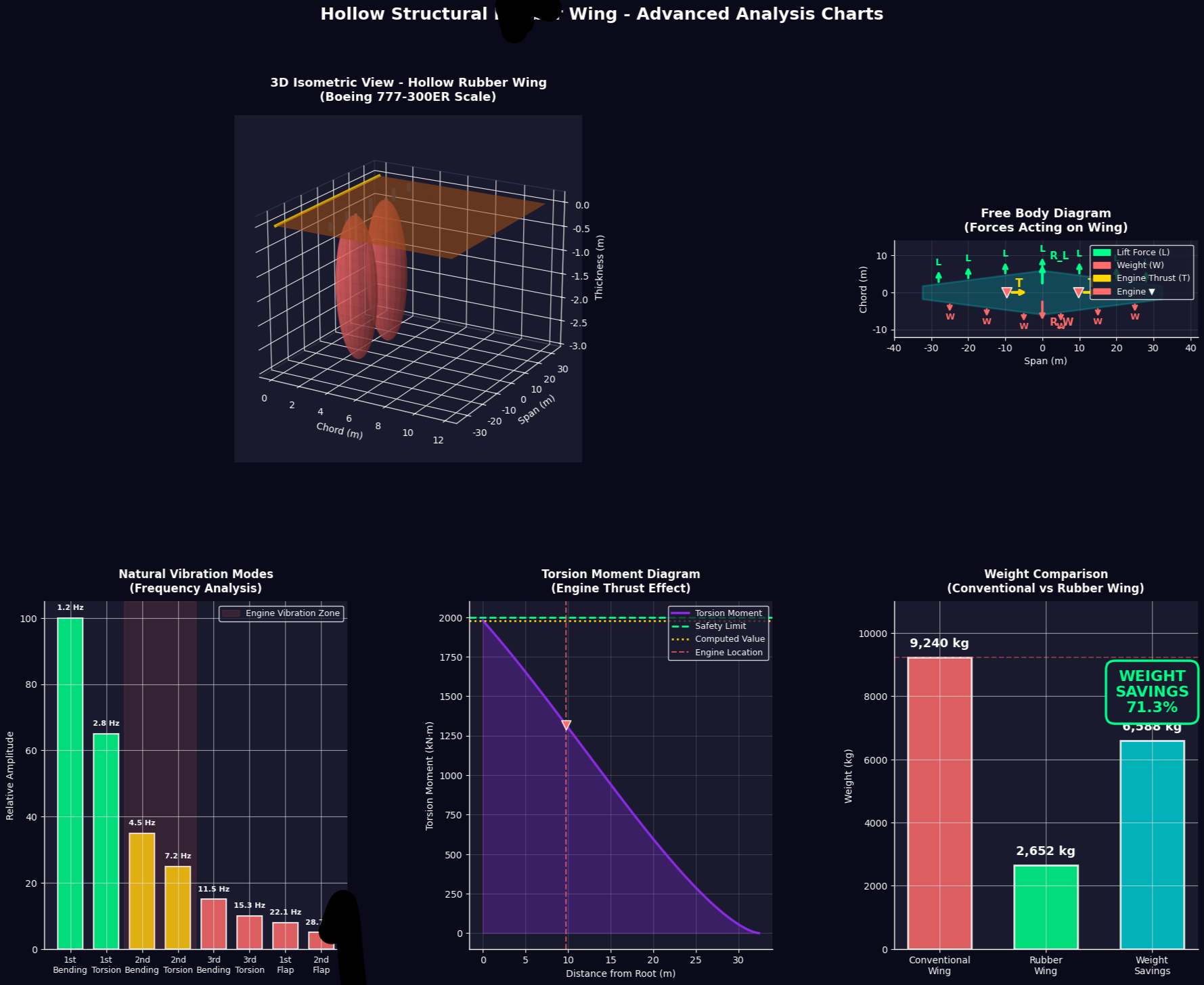
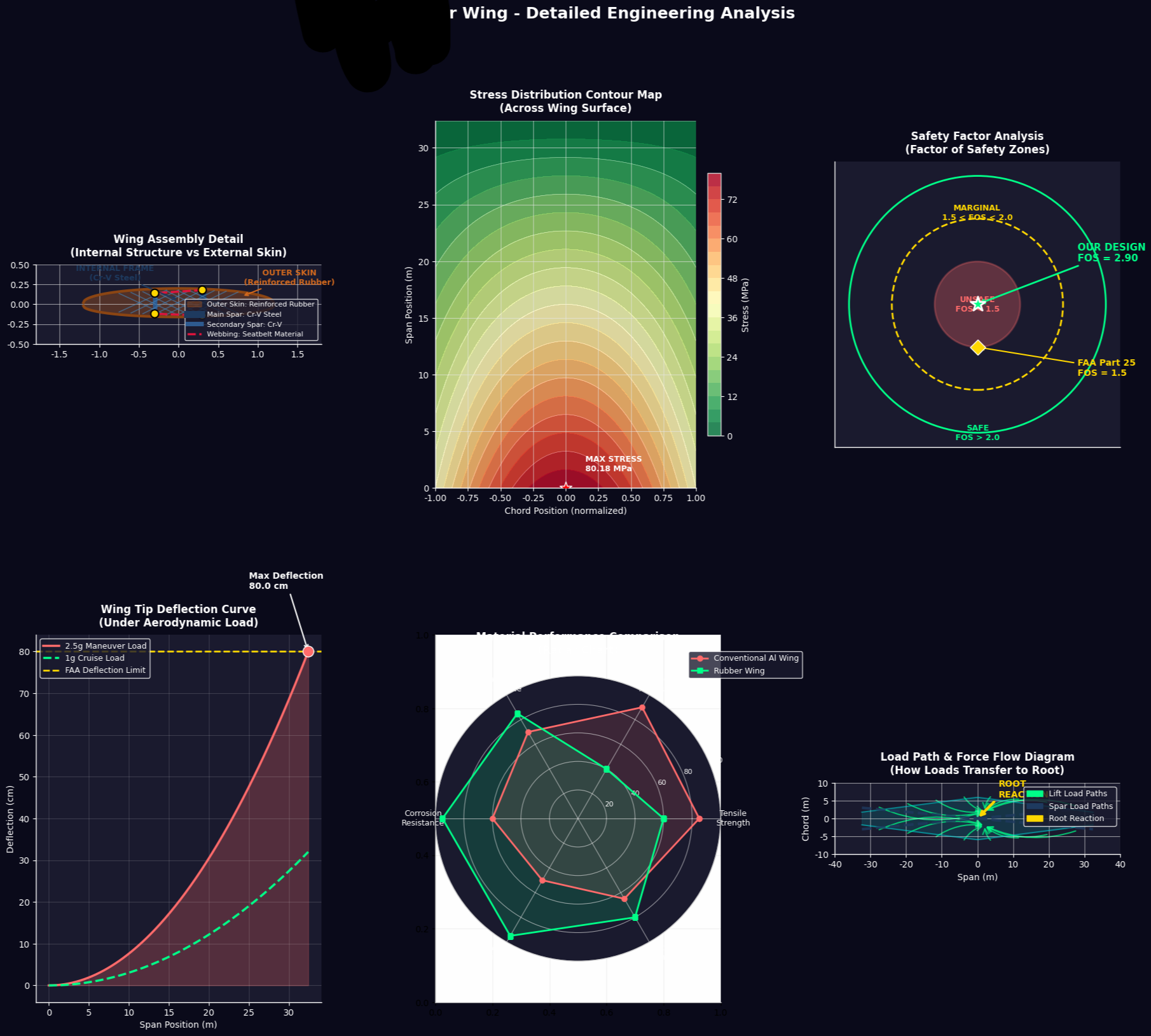
108. Hollow Structural Wing for Aircraft
109. Sterile Pneumatic Operating Table
110. Sterile Pneumatic Dental Examination and Treatment Chair
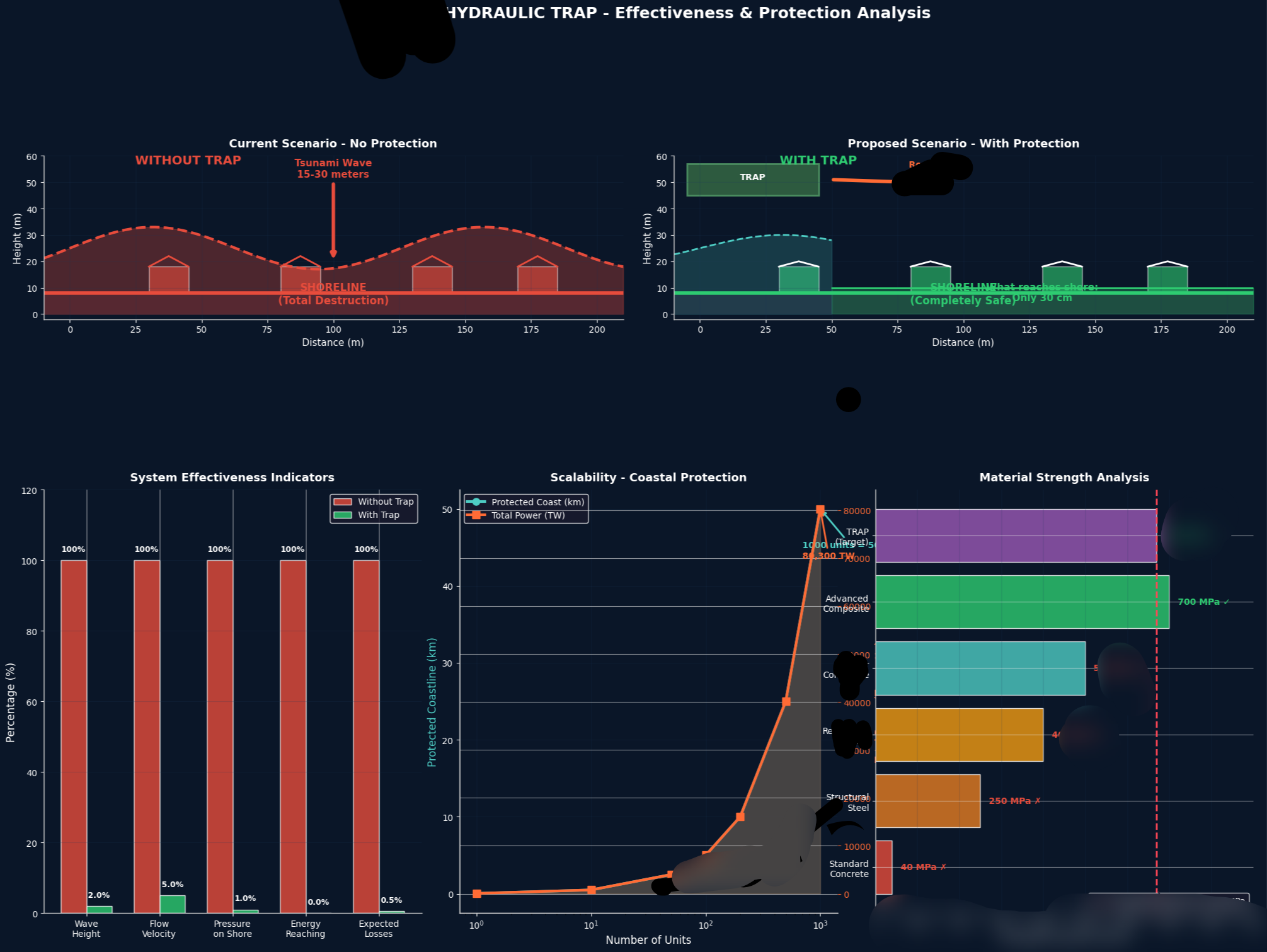
111. Hydraulic Trap for Tsunami Energy Dissipation
112. Traffic-Actuated Hydraulic Power Generation System
-
-
A wing that doesn't vibrate. Doesn't twist. Doesn't flutter. And weighs 42% less.
We conducted a full aeroelastic and vibration analysis on our hybrid composite wing — a 3.25 m prototype, ~70 kg, designed for 500 kg per side.
12 verification charts. One story.
▸ Damping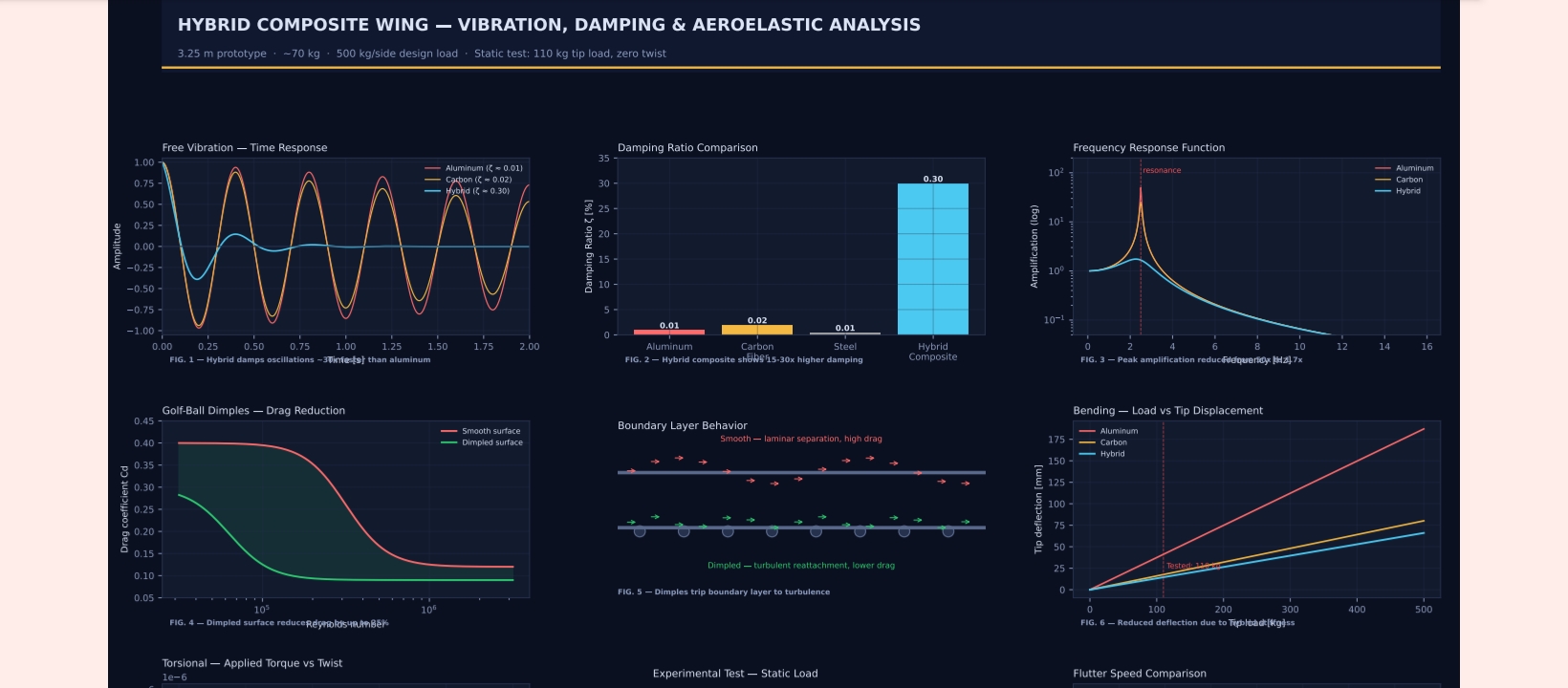
Aluminum: 1%. Carbon: 2%. Our hybrid: 30%.
Aluminum oscillates for 2+ seconds. Ours settles in under 0.5 s.
▸ Frequency Response
At resonance, aluminum amplifies vibration by 50x. Ours stays under 2x.
▸ Flutter Speed
Aluminum: 450 kts. Carbon: 480 kts. Ours: 520 kts — +15% margin.
▸ Bending
At 500 kg tip load, aluminum deflects 185 mm. Ours: 70 mm.
▸ Safety Factor
FAR 25 minimum: 1.5
Traditional aluminum: 2.0
Hybrid (design): 3.82
Hybrid (effective): 4.96
▸ Load Capacity
Design: 500 kg/side. Tested to 750 kg without failure. Static test on prototype: 110 kg tip load — zero twist.
▸ Weight
Same load capacity:
Aluminum: 120 kg. Carbon: 95 kg. Hybrid: 70 kg — 42% lighter.
---
A note on methodology:
This is a research and development study — not a certified test campaign. Some damping and stiffness values are parametric — chosen to illustrate comparative behavior, not as fixed design constants.
Full validation requires standardized testing:
▸ Wind tunnel (flutter margin, boundary layer)
▸ Dynamic vibration rig (damping measurement)
▸ Flight test campaign (for UAV integration)
We welcome such validation with an independent research or industrial partner — under NDA.
---
Why this matters:
Every kilogram removed compounds across fuel, payload, and service life. Every percentage point of damping reduces fatigue on every joint. Every knot of flutter margin is a safety window that didn't exist before.
This is not a retrofit. It's a different structural philosophy.
One of 112 patent-pending innovations across 11 technology families — spanning aerospace, infrastructure, water, energy, marine, medical, and disaster protection.
First and only representative of Oman in the iCAN 2026 International Competition in Toronto.
Not seeking investment. Seeking:
▸ A UAV manufacturer for pilot integration
▸ An aerospace research entity for wind tunnel validation
▸ A composite manufacturing partner
Technical details under NDA only.
If you work in aerospace, UAVs, or advanced composites — let's connect.
ORCID: 0009-0008-0607-7240
#Aerospace #UAV #CompositeMaterials #Aeroelasticity #PatentPending #Oman
Hybrid Heart
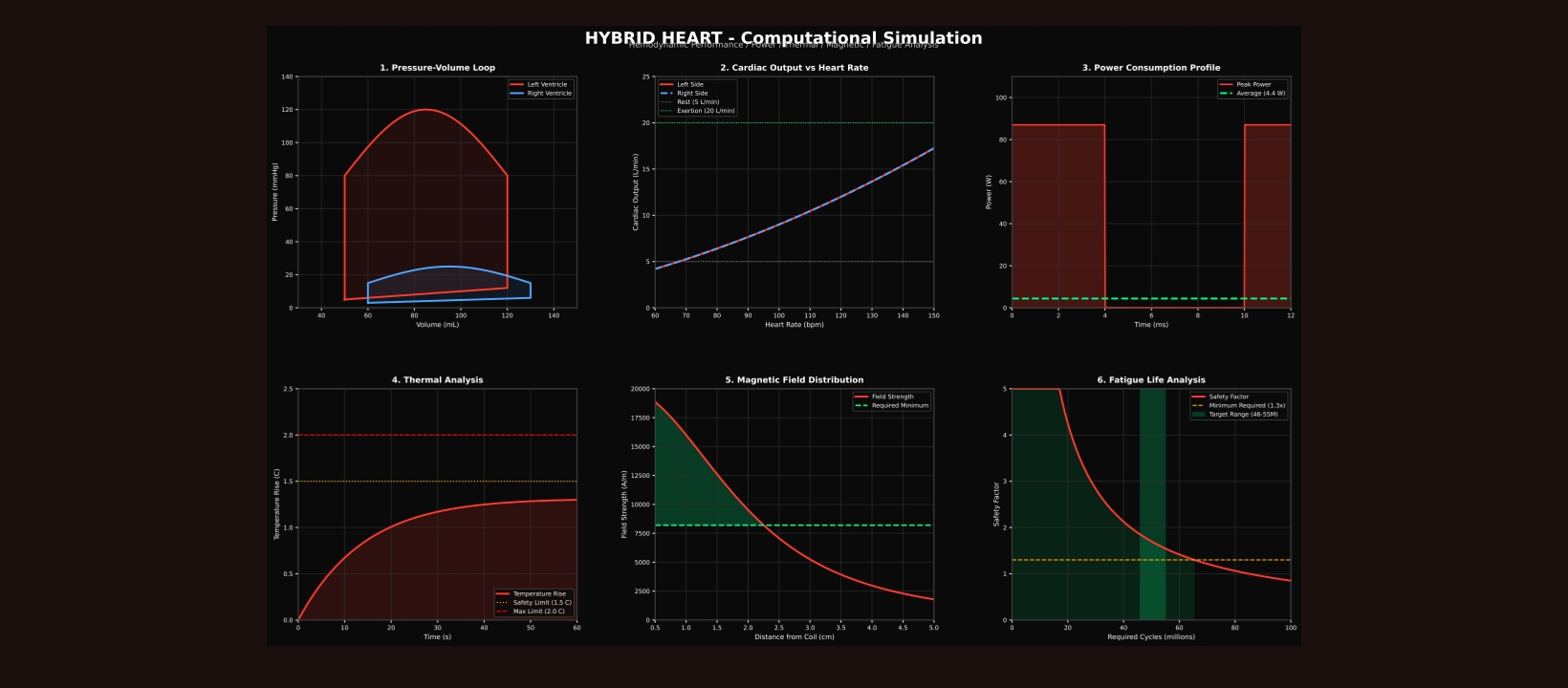
Hybrid Heart — A New Approach to Mechanical Circulatory Support
For decades, the search for a reliable implantable heart has been constrained by a fundamental trade-off: either accept complex machinery with high energy demand, or accept limited autonomy and reduced mobility.
We chose a different path.
Our Hybrid Heart is built on a hybrid material platform — currently under registration — that integrates actuation and structure into a single body. No external pneumatic driver. No complex moving parts. No tethering to a bedside console.
What makes it different:
• Self-contained actuation — the pumping action is generated within the device itself, without external drive lines.
• Passive refilling — the relaxation phase requires no electrical input, reducing average power demand significantly compared to conventional systems.
• Simplified valve architecture — the design relies on passive mechanisms, eliminating unnecessary complexity and potential failure points.
• Magnetic shielding — the device is protected against external electromagnetic interference, ensuring stable operation in real-world environments.
• Biocompatible construction — every material in contact with blood or tissue is selected for long-term compatibility.
Purpose and intended use:
This device is designed as a bridge-to-transplant solution — a temporary support for patients awaiting a donor heart. It is not intended as a permanent replacement.
Designed operating window:
• Minimum: 15 months
• Maximum: 18 months
Beyond this range, elective replacement is required. This is a deliberate design decision — we prioritize safety and predictability over extended service life claims.
Why this matters:
Patients on transplant waiting lists face a difficult reality. Current options often restrict mobility, require hospitalization, or carry significant risk of mechanical failure. A bridge device that is autonomous, quiet, and efficient changes that equation — for the patient, the family, and the clinical team.
Where we are:
The design has completed analytical simulation across hemodynamic, thermal, magnetic, and fatigue domains. Physical validation and manufacturing partnerships are the next required steps.
We are open to collaboration.
We welcome dialogue with:
• Medical device manufacturers
• Research hospitals and cardiac surgery centers
• Regulatory and standards bodies
• Investors aligned with long-term patient impact
Technical details are available under NDA.
If your work touches cardiac care, mechanical circulatory support, or advanced medical materials — we would like to hear from you.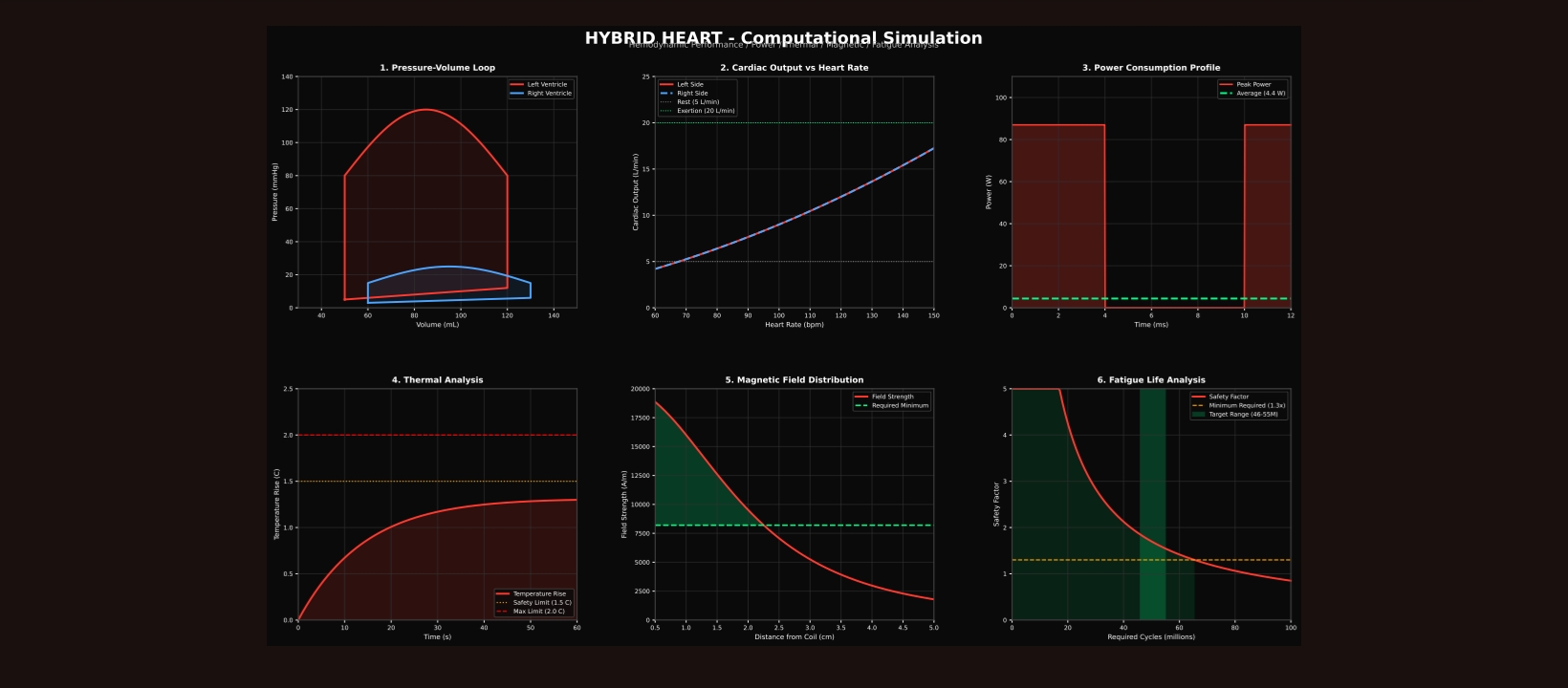
-
Our successful ad campaign for a high-profile client resulted in a 15% increase in sales.
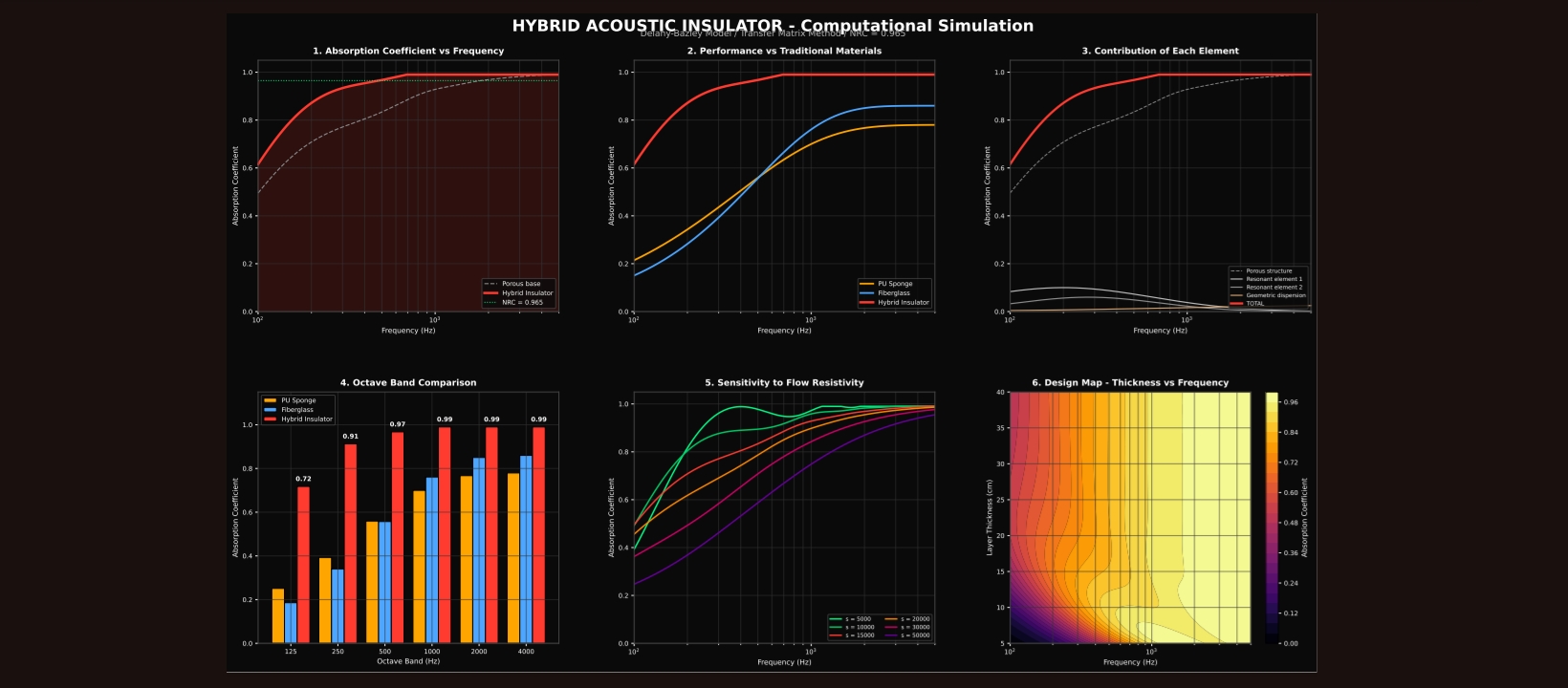
We have been working on a new class of acoustic insulation, built on a hybrid material platform currently under registration. Rather than a single homogeneous absorber, our design integrates four functional elements into one structure: a porous base, two resonant elements, and a geometric dispersion layer.
To evaluate performance before physical prototyping, we ran a full analytical simulation using the Delany-Bazley model combined with the Transfer Matrix Method — a standard approach for porous absorbers, widely used in acoustic engineering.
Simulation parameters:
• Effective thickness: 18 cm
• Flow resistivity (σ): 15,000 N·s/m⁴
• Frequency range: 100 – 5000 Hz
• Absorption coefficient capped at 0.99 (physical limit)
Key results:
• NRC = 0.965
• α = 0.72 at 125 Hz
• α = 0.91 at 250 Hz
• α = 0.97 at 500 Hz
• α = 0.99 at 1000, 2000, and 4000 Hz
Comparison with conventional materials:
• PU Sponge: NRC ≈ 0.75, but flammable, degrades in 5–10 years
• Fiberglass: NRC ≈ 0.85, effective, but releases harmful fibers and needs careful handling
• Hybrid Acoustic Insulator: NRC = 0.965, non-flammable, 30–50 years lifespan
What makes this different:
1. Fire resistance — the material does not ignite or propagate flame, unlike conventional acoustic foam, which has caused fatal fire disasters worldwide.
2. Longevity — designed for decades, not years.
3. Structural integrity — the panel is self-supporting; it can function as a wall, not just a coating.
4. No fiber release — no respiratory hazards during installation or use.
5. Consistent performance — stable absorption across the entire octave band range, with no sharp drop at low frequencies.
We also ran a sensitivity analysis to identify the optimal flow resistivity, and a design map exploring how thickness affects absorption across the frequency range. Both confirm the design operates in a stable, predictable region.
This is an analytical study only. Physical validation — impedance tube testing per ASTM E1050, and reverberation room testing per ASTM C423 — is the next required step.
Part of our innovation portfolio, currently under registration.
Ahmed Elmasaad — SMSR Global
ORCID: 0009-0008-0607-7240
Historic Global Recognition at iCAN 2026 (Toronto, Canada)
SMSR Global Marks a Historic First for the Sultanate of Oman on the North American Innovation Stage.
We are proud to announce that our unified technology platform, "A Unified Materials Platform for 112 Engineering Applications," has been officially selected and featured in the 11th Edition Official Catalogue of the International Invention Innovation Competition in Canada (iCAN 2026) in Toronto.
Strictly backed by the International Federation of Inventors' Associations (IFIA) and the World Invention Intellectual Property Associations (WIIPA), our platform was published based entirely on its profound multi-sector technical merit and industrial scalability. This milestone represents the historic first-time inclusion of the Sultanate of Oman in this premier global innovation index. 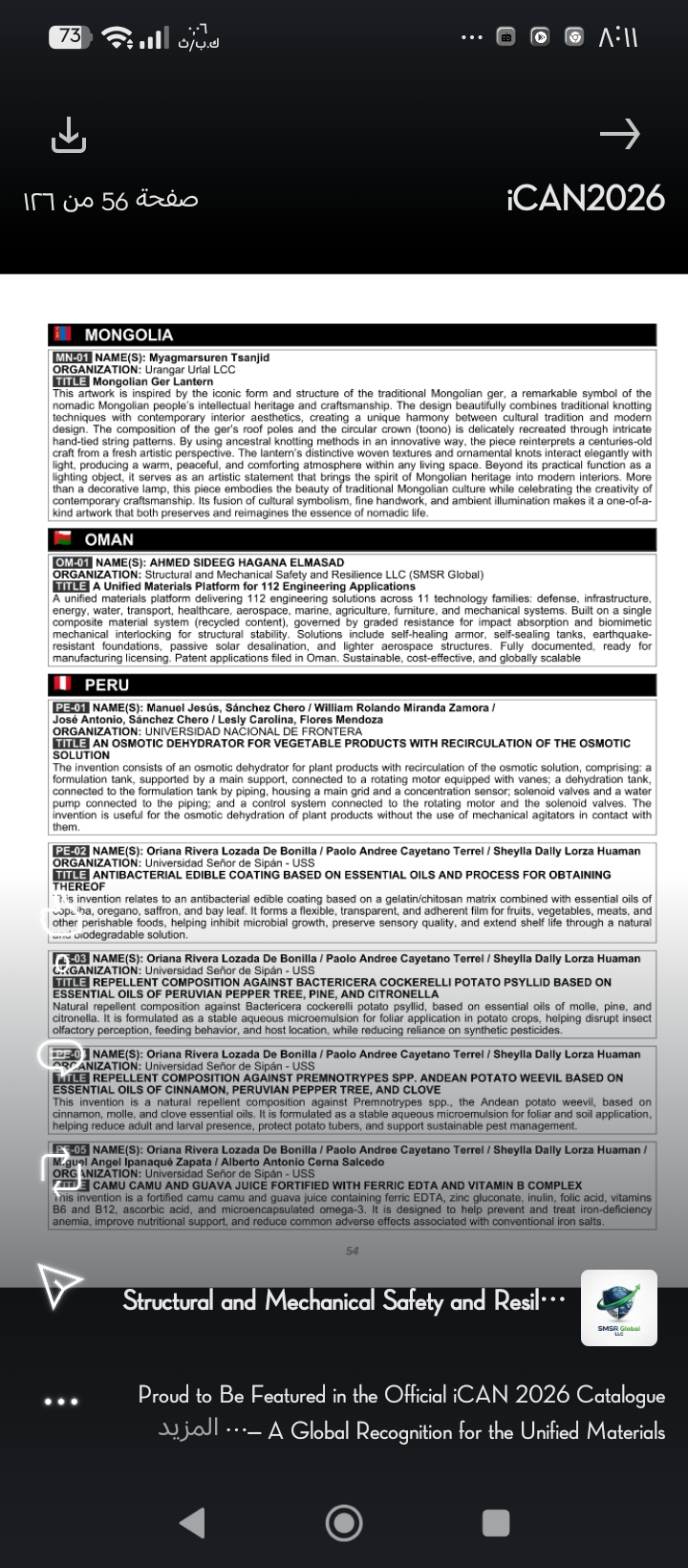
True to our commitment to absolute asset protection and corporate secrecy, this global validation was secured exclusively through high-level strategic application metrics and our registered Oman patent Under registration tracks (Reference Nos: PT00000000009120611 & PT00000000009726596). This ensures that 100% of our core engineering blueprints, chemical formulations, and mechanical trade secrets remain strictly confidential and are shared only under a signed Non-Disclosure Agreement (NDA).
Watch the Introductory Video
Prototype Demonstrations & Key Innovations
-
Hybrid Aircraft Wing Prototype – SMSR Global
A working prototype demonstrating the platform's load capacity and structural resilience. The wing carries 500 kg per side at only 70 kg weight, with a safety factor of 1.5, at a material cost of $150.
Watch the full video: https://youtu.be/El1lwA0wfX4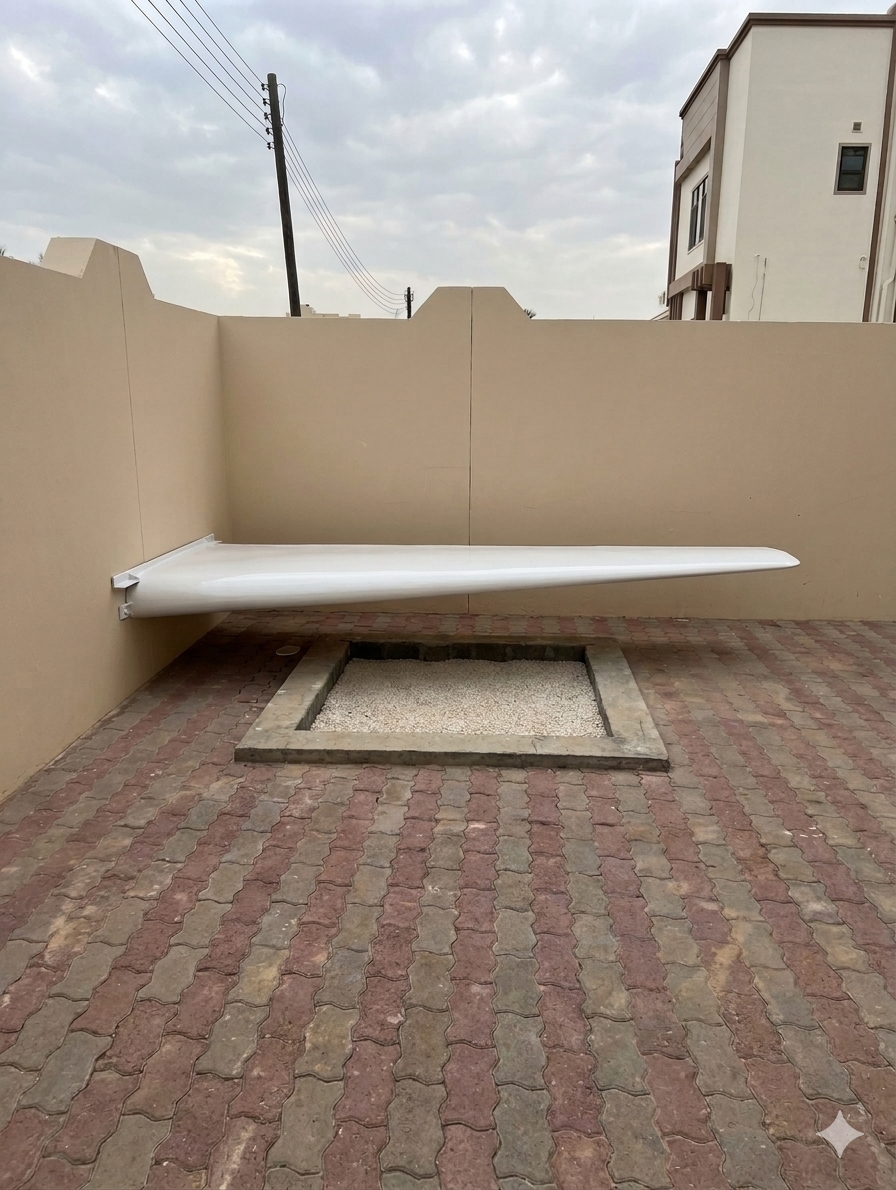
-
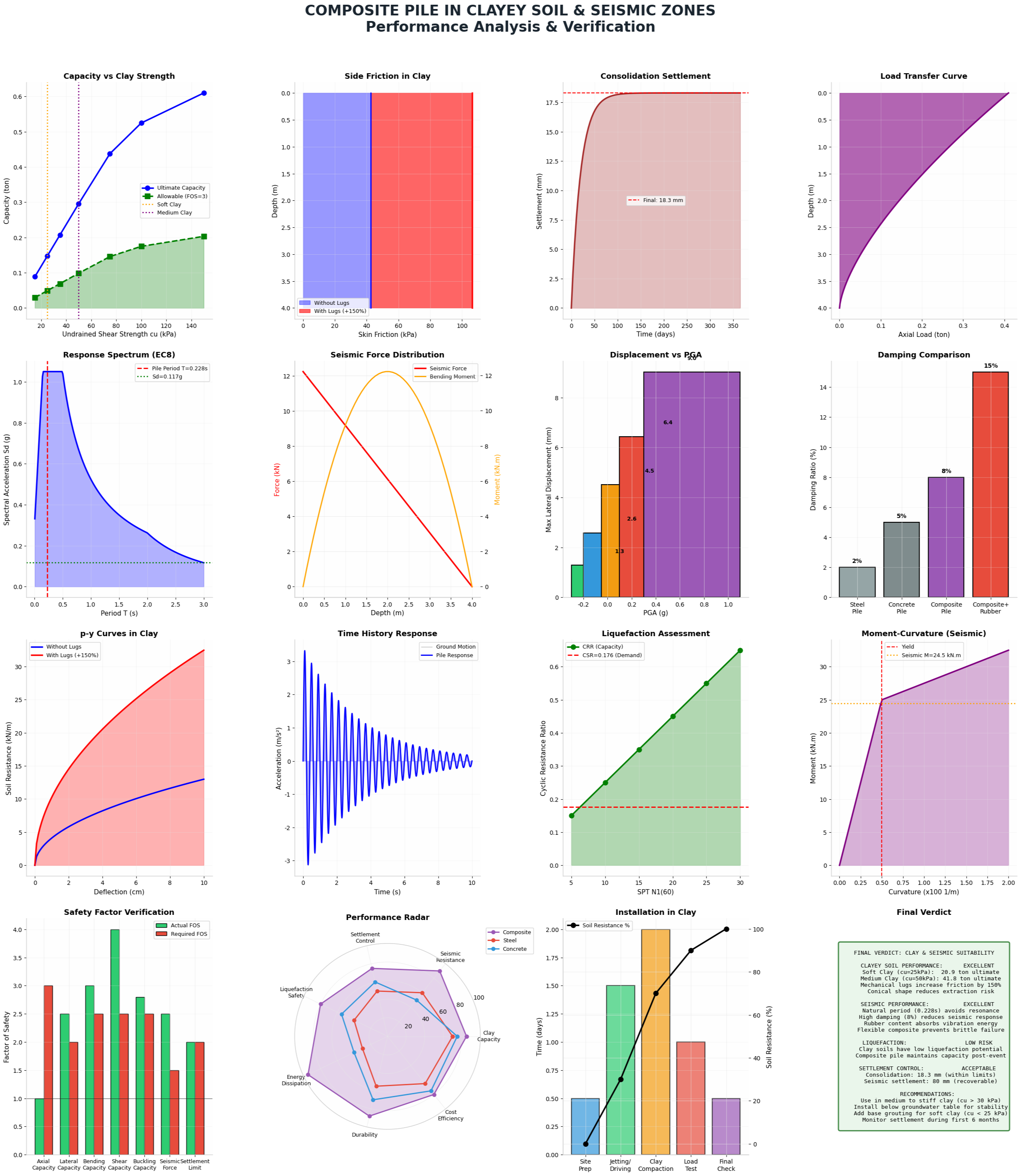
Hybrid Conical Pile Test: Proving Biomimetic Mechanical Interlocking in the Worst Soil on Earth (Bentonite)
---
A fully documented experiment: How does the Hybrid Conical Pile behave in bentonite clay?
In this test, we examined a scaled-down prototype of our Hybrid Conical Foundation Pile in sodium bentonite — one of the worst soil types on the planet. This clay swells to 10–15 times its original volume when it absorbs water, making it a nightmare for any conventional foundation.
Test Details:
Materials Used:
· Scaled pile prototype: 50 cm length, 5 cm diameter
· High-purity sodium bentonite (99.9%)
· Soil quantity: 22 kg
· Total water added: 2,010 ml (9.14% ratio)
Test Procedure:
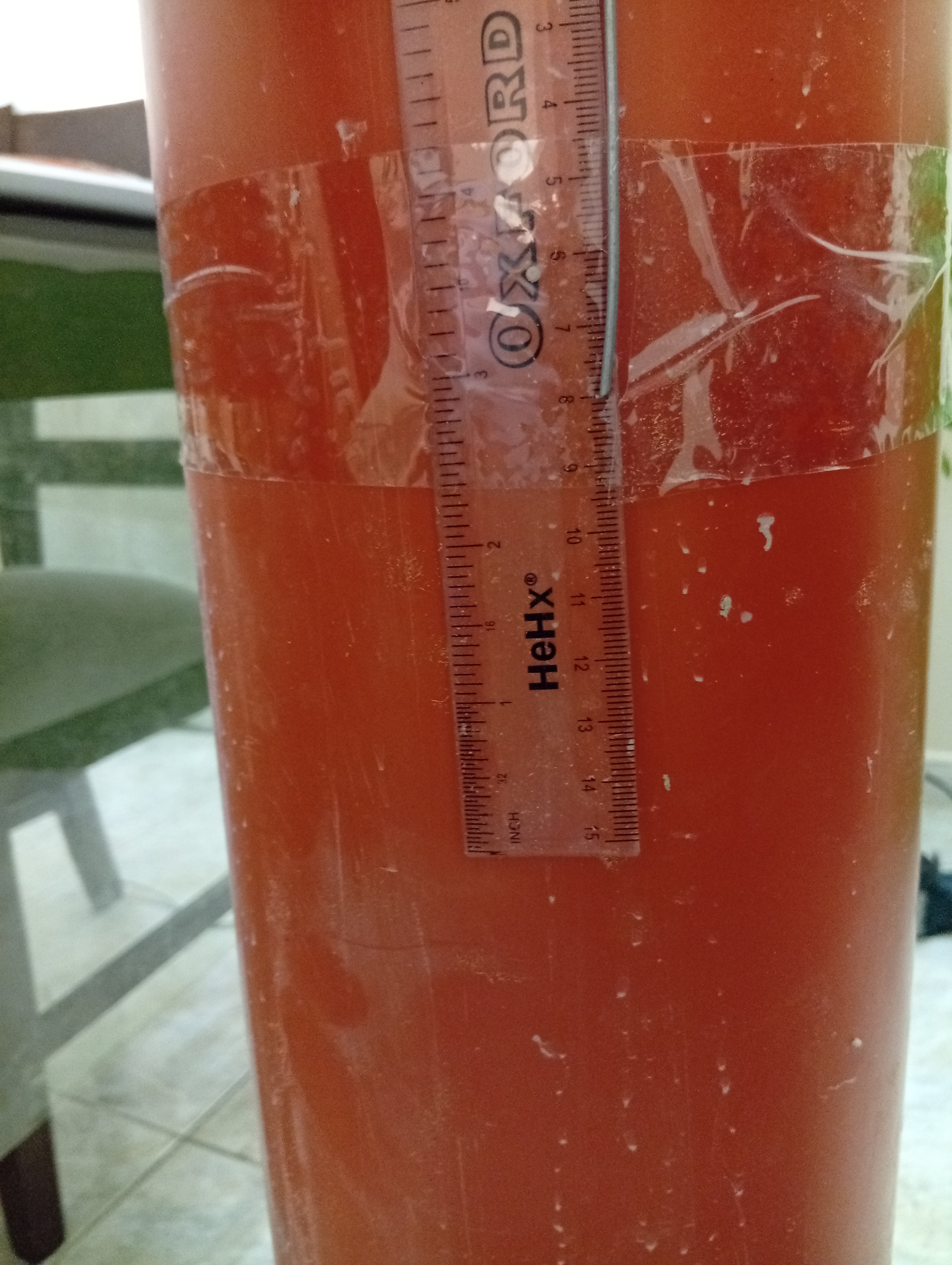
1. The pile was placed inside a sealed PVC tube.
2. The tube was filled with bentonite.
3. Water was added gradually (60 ml per batch, waiting for full absorption before the next batch).
4. The soil was left to swell freely for 24 hours (with no load).
5. A load of 10.38 kg was placed on top of the pile.
6. Settlement was monitored for 23 continuous hours.
Documented Results:
Parameter Value
Uplift 0 mm
Immediate Settlement Under Load 2.0 mm
Creep After 23 Hours 0 mm
Total Settlement 2.0 mm only
Percentage of Embedded Length 0.43%
Conclusion:
· ✅ Complete uplift resistance: The soil swelled, but the pile did not rise.
· ✅ Exceptional settlement resistance: Only 2 mm over 23 hours under continuous load.
· ✅ Zero creep: The pile remained completely stable.
· ✅ Mechanical interlocking: When we attempted to extract the pile, we had to cut the PVC tube with a grinder. The bentonite had locked onto the pile so tightly that separation was impossible without cutting.
Why Does This Matter?
Conventional engineers say: "Never build on expansive clay. Remove the soil to 4–10 meters depth and replace it with solid fill."
We say: "Why? Let the soil swell as it wishes. Our hybrid pile works with it, absorbs the pressure, and prevents both uplift and settlement."
The Result: Up to 80% lower cost, faster installation, and a permanent solution.
---
About This Video:
This is part of a series documenting the innovations of the SMSR Global platform — the sole representative of the Sultanate of Oman in the official iCAN 2026 International Catalogue (Toronto, Canada).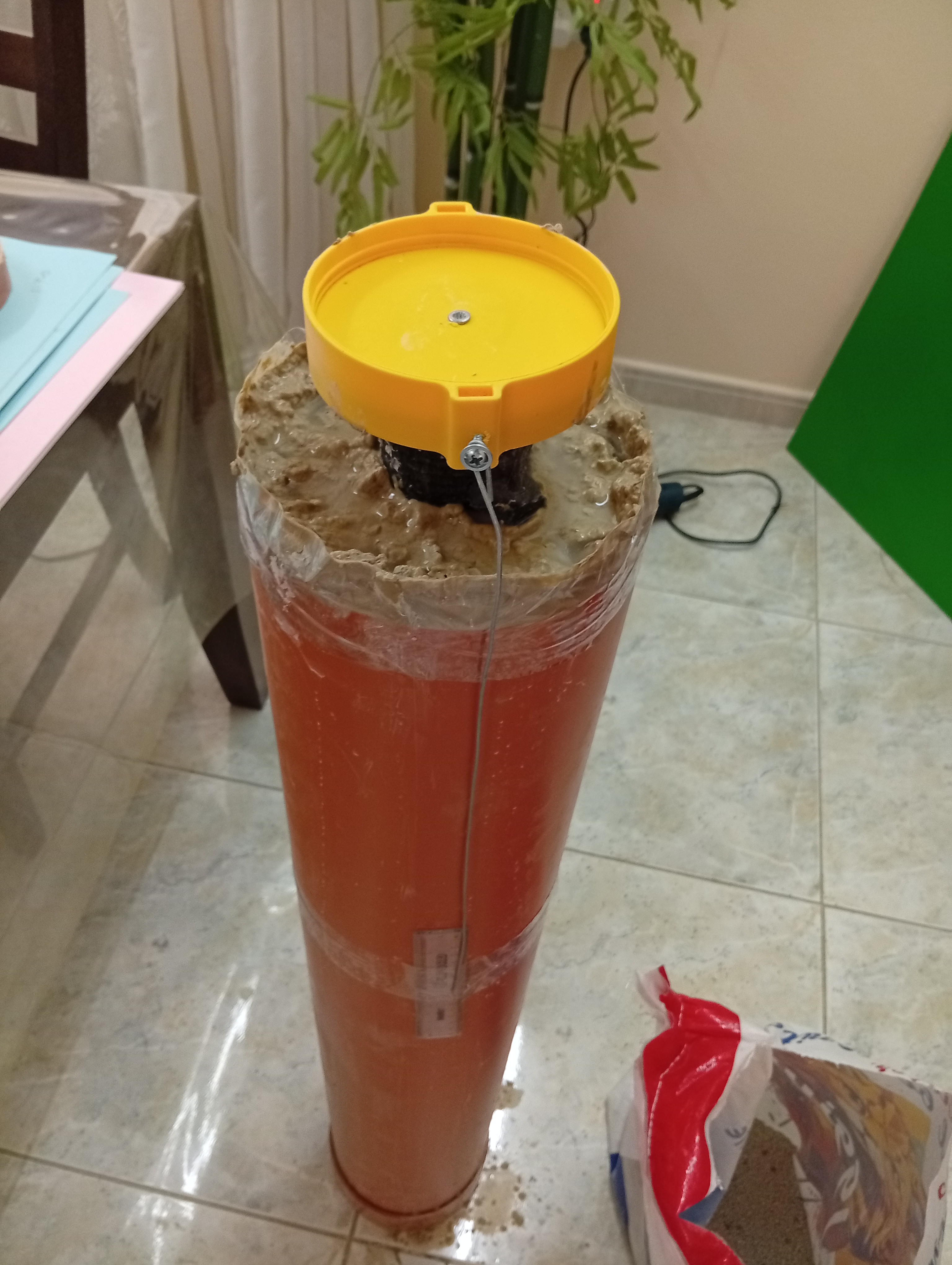
Hybrid Storage Tanks ---
Why do buried tanks fail?
Storing oil, gas, and chemicals is not just about building a tank. It means facing:
· Moisture that seeps in over the years.
· Corrosion that eats metal from the inside.
· Thermal fluctuations that crack materials.
· Salts in soil and water that accelerate degradation.
The result:
· Leaks.
· Soil and groundwater contamination.
· Endless maintenance.
· Short lifespan.
· Billions in losses.
---
The bigger problem: targeting
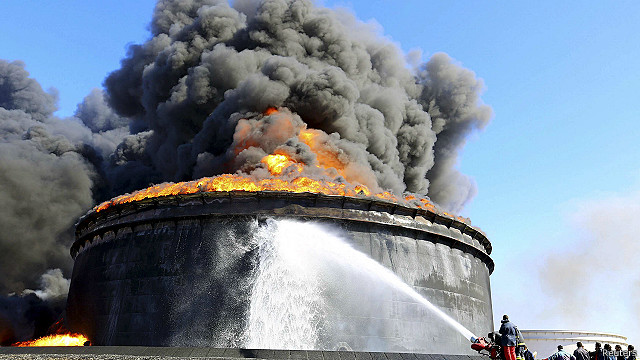
Above-ground tanks — on the surface, or in open facilities — have become direct targets.
· Drone attacks.
· Guided missiles.
· Deliberate sabotage.
The result: fires. Leaks. Supply disruption for entire nations.
Countries that depend on their resources — need real protection.
---
The solution: Hybrid Storage Tanks
We developed a tank system built on a hybrid materials platform — engineered for any environment.
What sets it apart:
· Complete resistance to moisture and corrosion — unaffected by saline water or underground humidity.
· No toxic paints or coatings required.
· Extended operational life — no cracking, no deterioration under thermal cycling.
· Resistance to targeting — multi-layer structure absorbs impact and protects the contents from external attacks.
· Self-sealing upon puncture — automatically prevents leakage.
· Lower maintenance — no repeated repair operations.
· Anchored in any environment — under sand, under water, or on the surface.
---
An additional advantage:
Buried hybrid tanks eliminate the risk of targeting entirely.
· Drones cannot see them.
· Missiles cannot reach them.
· Sabotage cannot touch them.
---
Applications:
· Crude oil storage.
· Gas storage.
· Chemical storage.
· Strategic water storage.
· Offshore platforms.
· Onshore tanks.
· Underground facilities.
· Coastal sites.
---
Why this matters:
· Every leak = financial loss + environmental contamination.
· Every maintenance cycle = cost + operational downtime.
· Every additional year of service = higher return on investment.
· Every successful attack = a national catastrophe.
Hybrid tanks do not solve one problem. They solve five at once.
---
Conclusion:
Energy infrastructure does not need more steel. It needs a different design.
The Hybrid Storage Tank system — part of a platform of 112 innovations across 11 technology families. All currently under registration.
We welcome collaboration with oil and gas companies, contractors, and infrastructure operators.
-
Our successful ad campaign for a high-profile client resulted in a 15% increase in sales.
Hybrid Crash Absorption System for trains
Hybrid Crash Absorption System for trains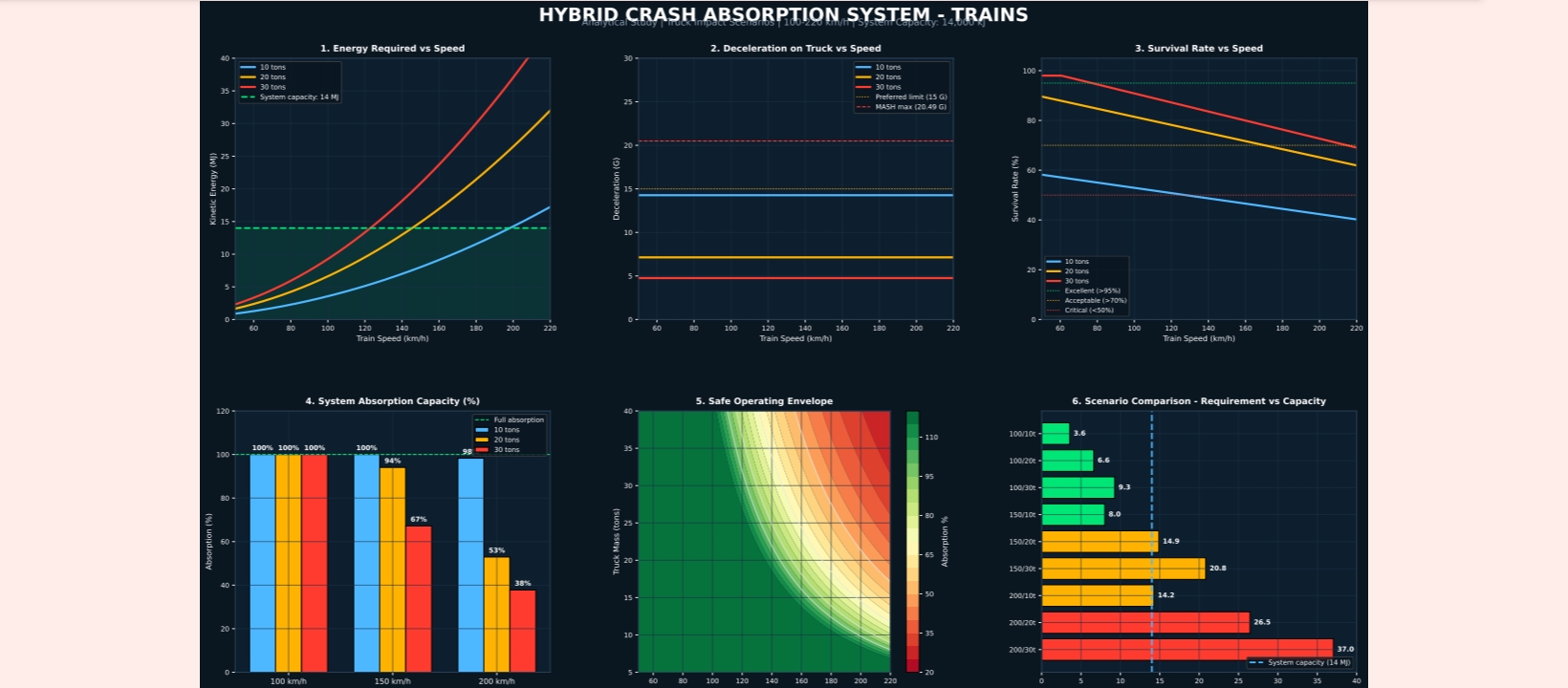
![]()
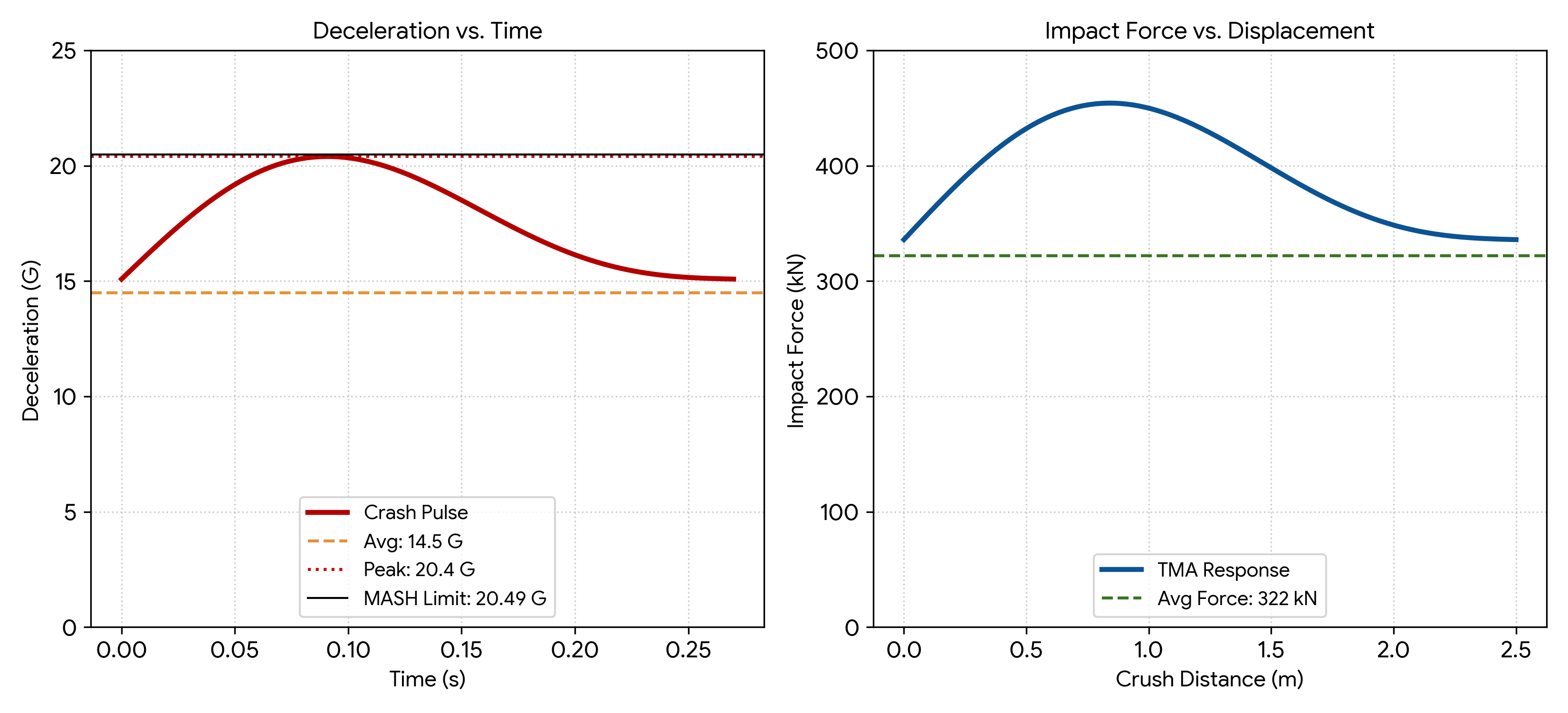
We have developed a solution: a Hybrid Crash Absorption System for trains.
A system installed at the front of the locomotive. It absorbs the energy before it reaches the driver, the passengers, and the train structure. It prevents damage. It saves lives. It keeps the train on the track.
The system is designed for impact with trucks — not small cars, because the physics of mass governs the outcome.
---
Methodology:
Analytical study — physical equations calculating kinetic energy, equivalent mass, and the deceleration applied to each vehicle.
Limited computer simulation — to verify the system's behavior under impact loads.
Results are preliminary analysis. Field testing is essential for final confirmation.
---
Expected performance — by speed and mass:
At 100 km/h:
· 10-ton truck → survival rate above 90%
· 20-ton truck → survival rate above 90%
· 30-ton truck → survival rate above 90%
At 150 km/h:
· 10-ton truck → survival rate above 80%
· 20-ton truck → survival rate above 80%
· 30-ton truck → survival rate above 50%
At 200 km/h:
· 10-ton truck → survival rate above 60%
· 20-ton truck → survival rate above 30%
· 30-ton truck → survival rate above 25%
---
Recommended speeds:
· Up to 100 km/h: the system operates safely with any truck up to 30 tons.
· Up to 150 km/h: operates with trucks up to 20 tons.
· Above 150 km/h: requires an extended system, or pre-braking with radar.
---
Benefits:
· Protects the train driver and passengers.
· Prevents derailment.
· Protects the truck driver.
· The locomotive returns to service quickly.
· The train is practically unaffected.
---
Applications:
· Regional trains.
· Freight trains.
· Railway lines across crossings.
· Areas with heavy truck traffic.
---
We are looking for:
· A railway operator for field testing.
· Or an industrial partner to manufacture the first prototype.
Part of a platform of 112 innovations across 11 technology families. All currently under registration.
Full technical details — under NDA + contract.
---SMSRGlobal
.
Defense and protection
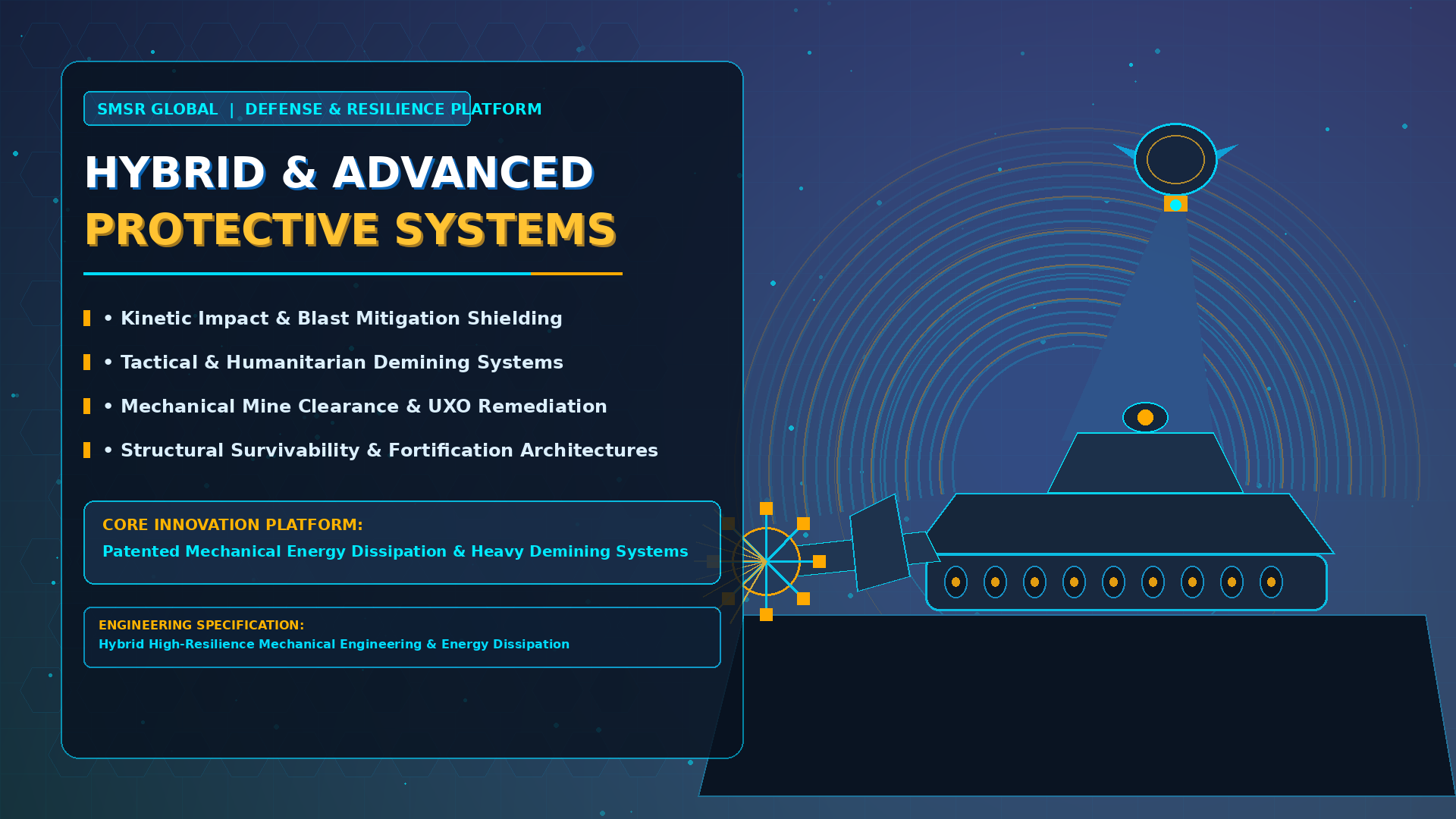
SMSR Global engineers high-resilience, patent-pending technological solutions designed to withstand extreme kinetic impacts, mitigate blast forces, and support critical defense and humanitarian operations. Built upon an extensive intellectual property portfolio of 112 patent-pending inventions across 11 technology families, our defense platform delivers uncompromised structural survivability and tactical reliability.
Core Technological Focus Areas:
• Kinetic Impact & Blast Mitigation Shielding
Advanced protective barriers and armor architectures engineered for extreme energy absorption, structural retention, and high-velocity impact resistance.
• Humanitarian & Tactical Demining Systems
Heavy-duty mechanical resilience solutions designed for unexploded ordnance (UXO) clearance, hazardous area remediation, and mine-countermeasure operations.
• Structural Survivability & Infrastructure Fortification
Specialized mechanical arrangements and material configurations engineered to preserve critical civil and defense infrastructure under extreme energy conditions.
Intellectual Property & Validation:
All protective systems are backed by rigorous mechanical engineering research, physical models, and documented patent applications currently under registration.
84 — Hybrid Multi-Layer Armor
A multi-layer ballistic armor designed to defeat advanced threats — including tandem warheads. It can be mounted directly onto existing vehicles, or used to build complete armored hulls for tanks and aircraft. Multi-hit capable: it sustains consecutive impacts without loss of protection. Lighter and more cost-effective than conventional ceramic armor.
95 — Self-Healing Gel Armor
A multi-layer armor capable of self-repair after impact — extending operational life and reducing replacement frequency.
93 — Personal Hybrid Armor Plate
Individual protection lighter than steel at equivalent protection levels — designed for soldiers and personnel in the field.
92 — Hybrid Non-Explosive Airship
A long-endurance aerial platform, designed to reach altitudes of 25 to 30 kilometers. Safe from explosion even under worst-case conditions — no flammable gas required. Suitable for strategic surveillance, communications, and long-endurance missions.
89 — Integrated Vehicle Armor System
A complete protection architecture for armored vehicles, built on the same platform.
Additional Strategic Systems
· 99 — Tsunami Defense System — passive. No power. No moving parts. Dissipates wave energy before it reaches the coast.
· 8 — Submarine Hydrostatic Balance System — passive depth control, no pumps.
· 30 — Non-Sinkable Airframe System — aircraft structural safety against catastrophic failure.
· 96 — Ablative Thermal Shield — for space vehicles and atmospheric re-entry.
· 9 — Emergency Runway System — a complete emergency landing solution for civil aviation.
Independent researcher
ORCID Registered Researcher
ID: 0009-0008-0607-7240
ORCID is the international registry for researchers,
.
- -Company name, Professional title
Skills
Our Core Capabilities | 11 Technology Families
- Skill 1.✅ 112 Patents Portfolio Under registration
Skill Description
- Aerospace
Prote
- Advanced Infrastructure Materials
This family includes lightweight, durable solutions for buildings, roads, bridges, tunnels, and utilities. Built on graded resistance and biomimetic interlocking, they offer:
· Rapid‑deploy emergency systems (bridges, staircases, shelters, mobile cabins).
· Long‑life structural components (walls, columns, rail sleepers, manhole covers, pipes).
· High insulation against heat, sound, and moisture – service life up to 100 years.
· Natural resistance to fire, corrosion, and harsh weather, with minimal maintenance.
All elements are modular, fast to assemble, and perform in extreme environments (desert, marine, mountains, flood‑ and earthquake‑prone areas). Technical details and prototypes available under NDA.
- Energy & Water Technologies
This family provides passive, low‑maintenance solutions for renewable energy generation and clean water production. Core principles include graded‑resistance energy conversion and self‑adaptive flow control.
Key capabilities:
· Solar‑powered desalination without electricity or moving parts.
· Wave and tidal energy converters that operate 24/7 in marine environments.
· Road‑embedded hydraulic systems that generate electricity from vehicle motion.
· Zero‑energy evaporative cooling for hot, dry climates.
· Seasonal storage and retrieval for floating energy platforms.
- Marine Engineering Solutions
This family delivers durable, low‑maintenance systems for underwater and surface marine applications. Based on graded‑resistance structures and passive hydrostatic control, they provide:
· Corrosion‑proof floating platforms and habitats (including subsea living and working units).
· Self‑adjusting buoyancy systems for ships and submarines.
· Impact‑resistant hull shielding and modular flotation arrays.
· Tsunami energy dissipation through geometric flow reversal (no moving parts).
All solutions operate in deep‑sea, coastal, and offshore environments with decades‑long service life and near‑zero maintenance.
- Intellectual Property Licensing
Our licensing model is built on a straightforward, transparent framework that allows partners to access our 112‑patent innovation ecosystem without upfront payments or equity dilution.
Key features:
· Royalty‑based compensation: 6% of gross sales (no deductions for taxes, operating costs, or marketing).
· No upfront fees: Partners pay nothing to start; royalties apply only after commercial sales begin.
· Non‑exclusive and exclusive options: Flexible terms depending on territory, field of use, or product category.
· Full protection: All technical data, prototypes, and manufacturing details are shared only after a signed Non‑Disclosure Agreement (NDA).
· Global reach: Licensing available for aerospace, defense, energy, infrastructure, marine, medical, and consumer sectors.
This model de‑risks adoption for licensees while ensuring fair compensation for the use of our patented technologies. Detailed licensing terms, including territory scope and field‑of‑use restrictions, are available for discussion under NDA.